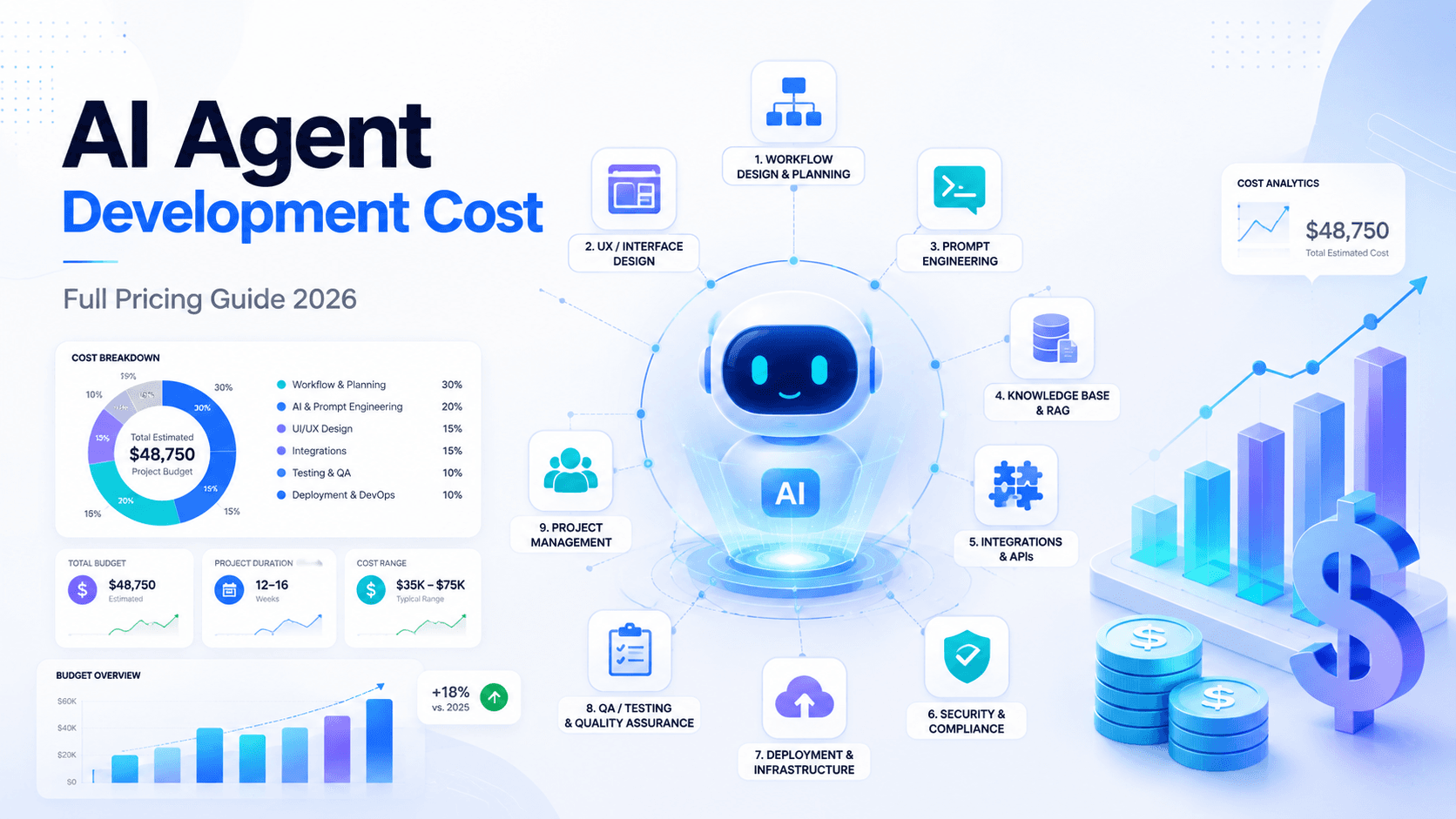
AI Agent Development Cost in 2026: A Complete Pricing Guide
AI agents are rapidly moving from experimental technology to practical business tools.
Companies are now using AI agents to automate customer support, qualify sales leads, analyze documents, manage internal knowledge, generate reports, update business systems, and complete multi-step operational tasks.
However, before starting an AI agent project, most businesses ask the same question:
How much does it cost to build an AI agent?
In 2026, AI agent development costs can range from approximately $10,000 for a simple proof of concept to more than $500,000 for a complex enterprise platform.
Most production-ready AI agent projects developed by software agencies fall between $25,000 and $200,000.
The final price depends on much more than the AI model being used. Integrations, data preparation, security, evaluations, user interfaces, infrastructure, workflow complexity, and maintenance can all significantly affect the overall budget.
This guide explains the average AI agent development cost, the main factors that influence pricing, common project types, monthly operating expenses, and practical ways to reduce development costs.
What Is an AI Agent?
An AI agent is a software system that uses artificial intelligence to understand a goal, decide what actions to take, interact with external tools, and complete a task across one or more steps.
Unlike a traditional chatbot that mainly generates text responses, an AI agent may be able to:
- Search a company knowledge base
- Read and classify documents
- Retrieve customer or order information
- Call internal and third-party APIs
- Update records in a CRM
- Send emails or notifications
- Generate reports
- Schedule meetings
- Ask users for missing information
- Escalate tasks to human employees
- Coordinate with other specialized agents
For example, a customer support chatbot may answer questions based on a predefined knowledge base.
A customer support AI agent could go further by identifying the customer, checking an order, reviewing the company’s refund policy, preparing a response, updating the support ticket, and requesting human approval before issuing a refund.
This additional autonomy makes AI agents more valuable than conventional chatbots. However, it also makes them more difficult to design, test, secure, and maintain.
How Much Does AI Agent Development Cost?
The cost of building an AI agent depends on the type of project and the level of complexity required.
Discovery or Feasibility Study: $5,000–$15,000
A discovery phase helps determine whether an AI agent is technically and financially suitable for a particular business process.
It may include:
- Business process analysis
- Use-case definition
- Technical feasibility assessment
- Data availability review
- Integration planning
- Risk identification
- Initial architecture design
- Development roadmap
- Preliminary cost estimate
A discovery phase usually takes between two and four weeks.
It is especially useful for businesses that have a general AI idea but have not yet defined the exact workflow, data requirements, or expected return on investment.
AI Agent Proof of Concept: $10,000–$25,000
A proof of concept, also known as a PoC, is designed to answer one main question:
Can an AI agent successfully handle this business process?
A typical proof of concept may include:
- One clearly defined use case
- A basic AI agent workflow
- One language model
- One or two simple integrations
- A limited test dataset
- Basic prompt engineering
- Basic output evaluation
- A simple internal interface
For example, a software agency might create a proof of concept that reads incoming customer support requests, identifies their category, and recommends an appropriate response.
A proof of concept is usually not ready for public release.
It may not include advanced security, detailed monitoring, extensive error handling, scalability, user management, or a polished interface.
Its main purpose is to test technical feasibility before investing in a larger system.
Basic Single-Agent MVP: $25,000–$80,000
A minimum viable product is suitable for internal testing or an initial release to a limited group of users.
A typical AI agent MVP may include:
- A web-based chat or task interface
- User authentication
- A company knowledge base
- Retrieval-augmented generation
- Two to four external tools
- Basic workflow memory
- Human approval for important actions
- Logging and error handling
- A basic evaluation dataset
- Cloud deployment
Examples of basic AI agent MVPs include:
- An internal company knowledge assistant
- A sales research agent
- A lead qualification agent
- A document summarization agent
- A customer support assistant
- A recruiting assistant
- A meeting preparation agent
- A content research assistant
A well-defined MVP is often the most cost-effective way to start an AI agent project.
It provides enough functionality to test user adoption and business value without immediately investing in a large enterprise architecture.
Production AI Agent: $80,000–$200,000
A production-ready AI agent must operate reliably under real business conditions.
In addition to the core AI workflow, the development team may need to build:
- Role-based access control
- Secure API connections
- CRM integrations
- ERP integrations
- Help desk integrations
- Database integrations
- Advanced document retrieval
- Structured output validation
- Workflow state management
- Human review and escalation paths
- Monitoring and tracing
- Automated evaluations
- Rate limits
- Cost controls
- Data privacy protections
- Backup and recovery processes
- Administrative dashboards
A production system must also handle unexpected situations.
These may include:
- Incomplete user information
- Unavailable APIs
- Incorrect model outputs
- Conflicting instructions
- Missing documents
- Slow external services
- Authentication errors
- Unexpected file formats
- Requests outside the agent’s permissions
Building the first working prototype is often relatively fast.
Making that prototype secure, reliable, scalable, and suitable for daily business use usually requires significantly more development time.
Enterprise or Multi-Agent System: $200,000–$500,000+
A multi-agent platform uses several specialized AI agents that collaborate or transfer tasks between one another.
For example, an enterprise sales platform might include:
- A market research agent
- A lead qualification agent
- A company intelligence agent
- A proposal generation agent
- A compliance-checking agent
- A CRM update agent
- A manager agent that coordinates the overall workflow
Enterprise AI agent systems may also require:
- Single sign-on
- Enterprise identity management
- Detailed audit logs
- Data residency controls
- Private cloud infrastructure
- Custom compliance policies
- Support for multiple departments
- Legacy system integrations
- High availability
- Disaster recovery
- Formal security assessments
- Extensive evaluation systems
- Red-team testing
- Dedicated technical support
A complex enterprise AI agent platform can exceed $500,000 when it affects critical business operations, processes sensitive data, supports multiple countries, or must serve thousands of users.
AI Agent Development Cost by Project Type
The following cost ranges can be used for early budget planning.
Discovery and feasibility study: approximately $5,000–$15,000
Proof of concept: approximately $10,000–$25,000
Basic AI agent MVP: approximately $25,000–$80,000
Production-ready AI agent: approximately $80,000–$200,000
Enterprise or multi-agent platform: approximately $200,000–$500,000+
These figures are planning estimates rather than fixed prices.
The exact cost will depend on the development team, project scope, required integrations, data quality, expected traffic, security requirements, and industry regulations.
What Factors Affect AI Agent Development Cost?
1. Workflow Complexity
Workflow complexity is one of the biggest factors affecting AI agent development cost.
A simple AI agent may receive a request, search a knowledge base, and produce an answer.
A more advanced agent may need to:
- Interpret the user’s goal
- Collect missing information
- Identify the correct business process
- Select an appropriate tool
- Call several external APIs
- Validate the returned data
- Ask for human approval
- Complete an external action
- Record the result
- Recover when one of the steps fails
Every additional decision, tool, condition, and exception increases development and testing time.
Long-running workflows are particularly challenging because the agent must maintain accurate information across multiple steps and potentially across several sessions.
2. Number of Integrations
Integrations are frequently one of the largest cost drivers in an AI agent project.
An agent may need to connect with platforms such as:
- Salesforce
- HubSpot
- Shopify
- WooCommerce
- Slack
- Microsoft Teams
- Google Workspace
- Zendesk
- Jira
- Notion
- Internal databases
- Proprietary company software
A modern and well-documented API may take only a few days to integrate.
A legacy system with incomplete documentation, outdated authentication, limited API access, or inconsistent data may require several weeks.
The type of permission also affects the cost.
An agent that only reads information is generally easier and safer to build than an agent that can:
- Issue refunds
- Change customer records
- Send emails
- Place orders
- Cancel subscriptions
- Modify inventory
- Approve expenses
- Update financial information
AI agents that can modify business data require stronger validation, permission controls, audit logging, and human approval mechanisms.
3. Data Preparation
Most business AI agents require access to private company information.
Before the agent can use this information effectively, the development team may need to:
- Collect documents from multiple systems
- Convert files into usable formats
- Remove duplicate information
- Identify outdated documents
- Clean inconsistent data
- Divide documents into searchable sections
- Generate embeddings
- Add metadata
- Store data in a vector database
- Apply access permissions
- Create synchronization pipelines
- Test retrieval accuracy
When company data is disorganized, data preparation can become one of the most expensive parts of the project.
The cost increases when the agent must process:
- Large document collections
- Frequently changing information
- Multiple languages
- Scanned documents
- Images
- Audio files
- Complex spreadsheets
- Permission-sensitive documents
- Information stored across multiple platforms
4. Retrieval-Augmented Generation
Retrieval-augmented generation, commonly known as RAG, allows an AI agent to search private company data before generating a response.
A basic RAG system may only need to search a small collection of documents.
A more advanced RAG system may require:
- Hybrid keyword and vector search
- Metadata filtering
- Permission-aware retrieval
- Document ranking
- Query rewriting
- Source citations
- Multilingual search
- Automatic data synchronization
- Duplicate detection
- Retrieval evaluation
The more reliable and accurate the knowledge system needs to be, the higher the development cost will become.
5. AI Model Selection
Developers can choose from several types of AI models, including:
- Premium reasoning models
- Smaller and faster language models
- Open-weight models
- Specialized embedding models
- Vision models
- Speech recognition models
- Text-to-speech models
- Self-hosted models
A more advanced model may produce better results for complex tasks, but using it for every request can significantly increase monthly operating expenses.
A common cost-optimization strategy is to use different models for different tasks.
For example:
- A smaller model can classify incoming requests
- A medium-sized model can generate standard responses
- A premium reasoning model can handle complex decisions
- A specialized embedding model can process knowledge-base documents
This model-routing approach can reduce operating costs without significantly reducing quality.
6. Agent Tools and Actions
A tool allows an AI agent to interact with an external system or perform a specific action.
Tools may include:
- Web search
- Database queries
- Calendar access
- Email delivery
- Code execution
- Payment processing
- File generation
- CRM updates
- Inventory checks
- Order tracking
- Internal API calls
Each tool requires:
- A clear description
- An input format
- Authentication
- Permission controls
- Input validation
- Output validation
- Error handling
- Logging
- Test coverage
Poorly designed tools can cause an AI agent to select the wrong action, provide incorrect parameters, or perform an action at the wrong time.
Tool design should therefore be treated as a core engineering task rather than a small integration detail.
7. User Interface Design
An internal AI agent operated through Slack or Microsoft Teams may require very little custom frontend development.
A customer-facing product may require:
- Responsive web design
- A custom chat interface
- File uploads
- Streaming responses
- Task progress indicators
- Approval screens
- Conversation history
- User feedback controls
- Admin dashboards
- Usage analytics
- Accessibility support
- Mobile compatibility
A custom interface can add approximately $10,000 to $50,000 or more to the total project cost, depending on its complexity.
8. Evaluations and Quality Assurance
Traditional software generally produces predictable results for the same input.
AI agent behavior is less deterministic. The same request may produce slightly different outputs depending on context, model behavior, retrieved documents, and external tool results.
Because of this, normal unit testing is not enough.
Development teams may need to create evaluation datasets that test:
- Task completion
- Tool selection
- Retrieval accuracy
- Output structure
- Hallucination rate
- Safety requirements
- Refusal behavior
- Escalation logic
- Response time
- Cost per successful task
- Behavior under unexpected inputs
Evaluation and quality assurance work can represent approximately 10% to 25% of the total development budget, especially for high-risk or customer-facing systems.
9. Security and Compliance
Security requirements depend on the information the AI agent can access and the actions it can perform.
Important security controls may include:
- User authentication
- Role-based authorization
- Data encryption
- Data retention policies
- Personal information filtering
- Prompt injection protection
- Tool access restrictions
- Human approval
- Audit logging
- Regional data storage
- Incident response procedures
- Security testing
Projects operating in regulated industries may also need to comply with specific requirements related to:
- Healthcare
- Financial services
- Insurance
- Legal services
- Education
- Government
- Personal data protection
Security should be included in the original project scope.
Adding security shortly before launch often causes delays and expensive rework.
10. Project Team Location
Development rates differ significantly between countries and regions.
A development team may include:
- Business analysts
- AI engineers
- Machine learning engineers
- Backend developers
- Frontend developers
- Data engineers
- DevOps engineers
- QA engineers
- UI and UX designers
- Project managers
- Security specialists
The total cost will depend on the number of specialists required, their experience, and their hourly or monthly rates.
An experienced AI development agency may charge more per hour than a general software outsourcing company. However, it may complete the project faster and avoid expensive architecture mistakes.
Example AI Agent Cost Breakdown
Consider a customer support AI agent for a mid-sized ecommerce company.
The agent needs to:
- Answer product questions
- Explain company policies
- Search customer information
- Check order status
- Track deliveries
- Draft customer responses
- Escalate sensitive cases
- Update the help desk
- Request human approval before issuing refunds
A possible development budget may include the following components.
Discovery and Workflow Design: $8,000
This phase includes:
- Business process analysis
- Use-case definition
- Technical planning
- Workflow mapping
- Risk identification
- Integration planning
- Success metric definition
UX and Interface Development: $12,000
This component may include:
- User experience design
- Chat interface design
- Approval screens
- Task status indicators
- Admin controls
- Responsive frontend development
Agent and Prompt Engineering: $25,000
This work may include:
- Agent architecture
- System instructions
- Prompt development
- Tool-selection logic
- Structured outputs
- Workflow orchestration
- Error recovery
- Conversation state management
Knowledge Base and RAG: $18,000
This component may include:
- Document collection
- Data cleaning
- Document processing
- Embedding generation
- Vector database setup
- Retrieval logic
- Metadata filtering
- Knowledge synchronization
Ecommerce and Help Desk Integrations: $25,000
This work may include connections to:
- Ecommerce platforms
- Order management systems
- Delivery services
- Customer databases
- Help desk software
- Refund systems
Evaluations and Quality Assurance: $15,000
This component may include:
- Test dataset creation
- Response-quality testing
- Tool-call testing
- Retrieval evaluation
- Error handling
- Performance testing
- Regression testing
Security and Deployment: $12,000
This work may include:
- Authentication
- Access controls
- Cloud infrastructure
- Logging
- Monitoring
- Data protection
- Production deployment
Project Management: $10,000
This component may include:
- Sprint planning
- Team coordination
- Stakeholder communication
- Progress reporting
- Scope management
- Release planning
Estimated Total Development Cost: $125,000
This figure is only an illustrative estimate.
A smaller internal AI agent could cost considerably less.
A system involving multiple languages, brands, countries, integrations, or regulatory requirements could cost significantly more.
Ongoing AI Agent Costs
Initial development is only one part of the total cost of ownership.
After launch, an AI agent may generate ongoing expenses for:
- Language model API usage
- Embedding generation
- Vector database storage
- Cloud hosting
- Background workers
- Monitoring and observability
- Search APIs
- Third-party software
- Data synchronization
- Evaluation runs
- Technical support
- Ongoing optimization
- Security updates
Typical Monthly AI Agent Operating Costs
Small Internal Pilot: $200–$1,500 per Month
This budget may be suitable for:
- A limited internal team
- Low request volume
- A small knowledge base
- Basic cloud hosting
- One or two integrations
- Limited monitoring
Examples include an internal document assistant or a small sales research tool.
Growing Business Application: $1,500–$10,000 per Month
This budget may be suitable for:
- Regular daily business usage
- A larger knowledge base
- Multiple integrations
- Production monitoring
- Automated data synchronization
- Several user groups
- Regular evaluation runs
Examples include a customer support assistant, lead qualification agent, or internal operations agent.
High-Volume Production Agent: $10,000–$50,000+ per Month
This budget may be suitable for:
- Customer-facing platforms
- High request volumes
- Advanced AI models
- Large document collections
- Complex integrations
- High availability
- Dedicated technical support
- Extensive monitoring
- Strict reliability requirements
Large enterprise systems may require an even higher custom infrastructure budget.
These operating estimates include more than AI model usage.
Hosting, databases, search services, monitoring tools, third-party APIs, data synchronization, and technical support can sometimes cost more than the AI model itself.
AI Agent Maintenance Cost
AI agents require ongoing maintenance after launch.
Annual maintenance commonly represents approximately 15% to 30% of the initial development budget.
Maintenance activities may include:
- Updating prompts
- Improving tool descriptions
- Fixing workflow errors
- Updating API integrations
- Rebuilding document indexes
- Monitoring performance
- Reviewing failed tasks
- Adding evaluation cases
- Updating security controls
- Switching AI models
- Reducing token usage
- Improving response speed
- Adding new features
For example, an AI agent that costs $100,000 to develop may require an annual maintenance budget of approximately $15,000 to $30,000.
The actual amount depends on usage volume, system complexity, business changes, and the level of support required.
In-House Development vs AI Development Agency
Businesses can build an AI agent with an internal team or hire a specialized development agency.
Both approaches have advantages and disadvantages.
Building an AI Agent In-House
An internal team provides direct control over the product and business knowledge.
However, the company may need to hire:
- AI engineers
- Backend developers
- Frontend developers
- Data engineers
- DevOps engineers
- QA specialists
- Security specialists
- Product managers
Building a complete internal AI team can require a substantial long-term investment.
In addition to salaries, the company must consider:
- Recruitment expenses
- Employee benefits
- Management costs
- Training
- Infrastructure
- Software subscriptions
- Staff retention
- Development delays
An internal team may be suitable for companies that plan to build several AI products and treat AI as a long-term strategic capability.
Hiring an AI Development Agency
An experienced AI development agency can provide:
- A ready-made multidisciplinary team
- Faster project setup
- Existing architecture knowledge
- Reusable integration components
- Evaluation experience
- Security expertise
- Defined delivery processes
- Flexible team scaling
The agency model is often suitable for companies that want to validate an idea or launch a production system without creating a permanent AI department.
When selecting an agency, businesses should evaluate more than its ability to connect an application to an AI model.
A reliable AI agent development company should be able to explain:
- How the workflow will be designed
- How the agent will access data
- How incorrect actions will be prevented
- How performance will be evaluated
- How sensitive information will be protected
- How operating costs will be controlled
- How the system will be monitored after launch
How to Reduce AI Agent Development Costs
Start With One High-Value Workflow
Avoid trying to automate an entire department in the first release.
Start with a workflow that is:
- Repetitive
- Time-consuming
- Easy to measure
- Supported by accessible data
- Safe to test with human review
Good initial use cases may include:
- Classifying support tickets
- Preparing sales research
- Summarizing internal documents
- Drafting standard responses
- Extracting information from invoices
- Updating CRM records
- Answering internal policy questions
A focused agent is generally easier to build, test, and improve.
Build a Proof of Concept First
A proof of concept allows the business to test technical feasibility before committing to full production development.
It can help answer questions such as:
- Is the company’s data suitable?
- Can the model understand the workflow?
- Are the required integrations available?
- Is the output accurate enough?
- Will employees use the system?
- Does the agent create measurable business value?
Discovering a major limitation during a $15,000 proof of concept is much less expensive than discovering it after spending $150,000 on a production platform.
Use a Single Agent Before Building Multiple Agents
Multi-agent architecture is not automatically better.
A single agent with several well-designed tools may be sufficient for many business processes.
Multiple agents should only be introduced when:
- Responsibilities are clearly different
- Separate expertise is required
- One agent cannot manage the workflow reliably
- Tasks can be divided into independent stages
- Specialized security permissions are needed
Starting with a single agent reduces orchestration, monitoring, evaluation, and debugging costs.
Add Human Approval to High-Risk Actions
Human approval can reduce risk and simplify the first version of an AI agent.
For example, the agent can prepare:
- A refund request
- A customer email
- A contract change
- A purchase order
- A CRM update
- A financial report
An employee can then review and approve the action before it is completed.
This approach allows the system to save time without giving it complete control over sensitive operations.
Use Existing AI Models
Most companies do not need to train a foundation model from scratch.
Using an existing commercial or open-weight model is usually faster and more affordable.
The development team can focus on:
- Business workflows
- Company data
- Integrations
- Tool design
- Security
- Evaluations
- User experience
Custom training or self-hosting should only be considered when there is a clear requirement related to privacy, performance, scale, or specialized domain behavior.
Control Context and Token Usage
Long prompts, unnecessary conversation history, repeated documents, and inefficient agent loops can increase monthly operating expenses.
Cost-optimization techniques include:
- Prompt caching
- Shorter system instructions
- Context summarization
- Retrieval filters
- Model routing
- Maximum step limits
- Structured outputs
- Reusing tool results
- Removing duplicate context
- Moving deterministic work into normal code
Not every task needs to be completed by an AI model.
Calculations, validation, formatting, and standard business rules are often cheaper and more reliable when handled by traditional software.
Build Evaluations Early
Without evaluations, teams may repeatedly fix individual failures without knowing whether the overall agent is improving.
A representative evaluation dataset should be created during the MVP stage.
It may include:
- Common user requests
- Difficult requests
- Incomplete requests
- Incorrect information
- Tool failures
- Security attacks
- Requests outside the agent’s scope
- High-risk actions
Early evaluations reduce the risk of expensive redesigns later.
Improve Data Before Adding More AI
When an agent provides poor answers, the problem is not always the AI model.
The real issue may be:
- Outdated documents
- Duplicate information
- Missing metadata
- Weak access controls
- Incorrect data
- Poorly structured business processes
Improving the company’s data can produce better results than switching to a more expensive model.
How to Estimate Your AI Agent Budget
Before requesting a development proposal, define the following information.
What Business Process Should the Agent Complete?
Avoid broad goals such as “automate customer service.”
Describe the exact workflow.
For example:
“Read incoming support tickets, identify the customer’s issue, retrieve relevant order information, draft a response, and escalate refund requests to a human employee.”
Who Will Use the Agent?
The project cost may differ depending on whether the agent is used by:
- Internal employees
- Existing customers
- Website visitors
- Sales teams
- Customer support teams
- Managers
- External partners
What Systems Must It Access?
List all required platforms, databases, and APIs.
Examples include:
- CRM
- ERP
- Help desk
- Ecommerce platform
- Calendar
- Internal database
- Document storage
- Payment system
Can the Agent Modify Data?
An agent that only reads information is simpler than an agent that can modify business systems.
Specify whether the agent needs permission to:
- Send messages
- Update records
- Cancel orders
- Issue refunds
- Create invoices
- Schedule meetings
- Approve requests
How Many Tasks Will It Process?
Estimated usage helps determine infrastructure and monthly model costs.
Useful metrics include:
- Number of users
- Requests per day
- Documents processed per month
- Average conversation length
- Expected response time
- Peak traffic
What Happens When the Agent Is Uncertain?
Define a fallback process.
The agent may:
- Ask the user for clarification
- Search another data source
- Retry the tool
- Transfer the task to an employee
- Stop the workflow
- Create a support ticket
Which Actions Require Human Approval?
Identify actions that could create financial, legal, security, or customer-service risks.
What Accuracy Level Is Acceptable?
An internal brainstorming assistant may tolerate occasional mistakes.
An agent that processes payments, contracts, healthcare information, or financial data requires a much higher level of accuracy and testing.
Does the System Process Sensitive Data?
Sensitive data may require additional security, compliance, infrastructure, and legal review.
How Will Success Be Measured?
Possible metrics include:
- Time saved
- Cost per task
- Resolution rate
- Response time
- Customer satisfaction
- Employee adoption
- Conversion rate
- Error rate
- Escalation rate
- Revenue generated
Clear requirements allow an AI development agency to provide a more accurate estimate and reduce unexpected scope changes.
Frequently Asked Questions
How Much Does It Cost to Develop an AI Agent?
A basic AI agent proof of concept may cost between $10,000 and $25,000.
A production-ready custom AI agent commonly costs between $80,000 and $200,000.
Enterprise or multi-agent systems may cost between $200,000 and $500,000 or more.
How Long Does It Take to Build an AI Agent?
A proof of concept may take between three and six weeks.
A basic MVP commonly takes between two and four months.
A production or enterprise AI agent may require between four and twelve months, depending on integrations, data, security, and testing requirements.
Can an AI Agent Be Built for Less Than $20,000?
Yes, when the project is limited to a proof of concept or a simple internal workflow.
The project should use existing AI models, require only a few integrations, operate on a limited dataset, and keep a human involved in important decisions.
What Is the Most Expensive Part of AI Agent Development?
For many projects, the largest costs are:
- Engineering labor
- System integrations
- Data preparation
- Security
- Evaluations
- Production reliability
AI model API fees are important, but they are not always the largest expense.
Are Multi-Agent Systems More Expensive?
Yes, in most cases.
Multi-agent systems require additional:
- Orchestration
- Communication logic
- State management
- Monitoring
- Evaluation
- Debugging
- Infrastructure
A multi-agent design should only be used when it provides a clear advantage over a simpler single-agent workflow.
How Much Does AI Agent Maintenance Cost?
Annual maintenance commonly represents approximately 15% to 30% of the original development cost.
Maintenance may include monitoring, bug fixes, prompt improvements, integration updates, model changes, evaluation maintenance, and infrastructure optimization.
Is It Cheaper to Use an Existing AI Model?
Yes, in most cases.
Using an existing foundation model is significantly faster and less expensive than training a model from scratch.
The development team can focus on workflows, company data, tools, integrations, security, and user experience.
What Is the Monthly Cost of Running an AI Agent?
A small internal pilot may cost approximately $200 to $1,500 per month.
A growing business application may cost approximately $1,500 to $10,000 per month.
A high-volume production agent may cost $10,000 to $50,000 or more per month.
The actual cost depends on model selection, request volume, context size, infrastructure, databases, integrations, and support requirements.
Final Thoughts
AI agent development cost depends primarily on what the agent must accomplish, which systems it must access, and how reliably it must perform.
A small proof of concept may require an investment of approximately $10,000.
A useful business MVP may cost between $25,000 and $80,000.
A secure, production-ready AI agent connected to several business systems will often require a budget between $80,000 and $200,000.
Complex enterprise or multi-agent platforms may cost more than $500,000.
The most effective approach is not to build the most autonomous AI agent possible.
Businesses should begin with one measurable workflow, prove that the system creates value, and expand it gradually based on real user feedback and performance data.
At Nextchain, we help businesses evaluate AI agent opportunities, design reliable workflows, build custom integrations, and deploy production-ready AI solutions.
Planning an AI agent project? Contact Nextchain to receive a technical consultation and a development cost estimate based on your specific use case.