AI Coding Agents in Software Development: A Complete Guide for 2026
Artificial intelligence has been assisting developers for several years, but the role of AI in software development is changing quickly.
Earlier AI coding tools mainly suggested individual lines of code, completed functions, or explained error messages. In 2026, a new generation of tools can analyze an entire codebase, plan a solution, modify multiple files, run commands, execute tests, review its own changes, and prepare a pull request for human approval.
These systems are commonly known as AI coding agents.
Products such as OpenAI Codex, Claude Code, and GitHub Copilot coding agent are designed to handle software development tasks across multiple steps instead of responding to one isolated prompt. OpenAI describes Codex as capable of completing features, refactors, migrations, tests, and code reviews, while Anthropic states that Claude Code can read codebases, edit files, run commands, and work with existing developer tools. GitHub’s cloud coding agent can receive an assigned task and return a pull request for review.
For software companies, this creates an important opportunity. AI coding agents can reduce the time developers spend on repetitive work and help teams complete more tasks without immediately increasing headcount.
However, these systems also create new questions:
- How reliable is AI-generated code?
- How much does an AI coding agent cost?
- Which software tasks should be delegated?
- How should companies protect their source code and credentials?
- Will faster code generation create more technical debt?
How should developers review work produced by AI agents?
This guide explains how AI coding agents work, their main benefits, implementation costs, security risks, ideal use cases, and the steps businesses can take to adopt them responsibly.
What Is an AI Coding Agent?
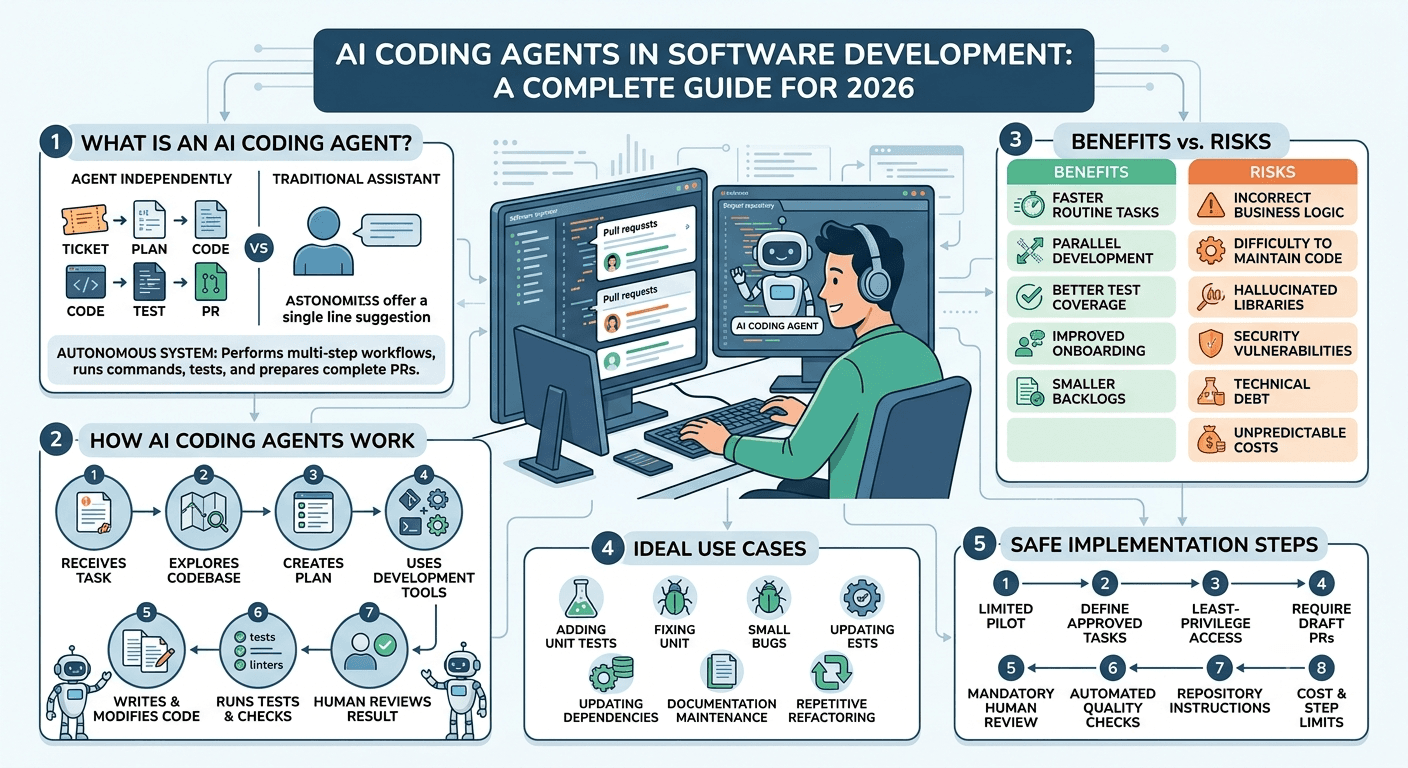
An AI coding agent is an AI-powered software system that can independently perform multiple steps within a software development workflow.
Instead of generating a single code snippet, an AI coding agent may be able to:
- Read a project repository
- Search for relevant files
- Understand dependencies
- Analyze an issue or feature request
- Create an implementation plan
- Modify several files
- Run terminal commands
- Install dependencies
- Generate tests
- Execute tests and linters
- Review its own changes
- Fix detected problems
- Create a branch
- Prepare a pull request
- Respond to review feedback
The main difference is autonomy.
A normal AI coding assistant waits for the developer to provide a new instruction after each response. A coding agent can continue through a sequence of actions, inspect the results, and decide what to do next.
For example, a developer might assign the following task:
Add password-reset functionality to the application and include unit tests.
A traditional coding assistant might explain how to build the feature or generate a sample function.
An AI coding agent could inspect the authentication system, identify the relevant files, add the new endpoint, create an email template, update the database logic, write tests, run the test suite, fix errors, and prepare the code for human review.
This does not mean the agent truly understands the business in the same way an experienced engineer does. It means the agent can operate across a wider development environment and complete more of the workflow before requiring human input.
AI Coding Agent vs AI Coding Assistant
The terms “AI coding assistant” and “AI coding agent” are sometimes used interchangeably, but they represent different levels of capability.
AI Coding Assistant
An AI coding assistant usually works interactively with a developer.
It may:
- Suggest the next line of code
- Complete a function
- Explain unfamiliar code
- Generate a regular expression
- Answer technical questions
- Refactor a selected block
- Help debug an error
The developer remains directly involved in every step.
AI Coding Agent
An AI coding agent can receive a broader objective and decide how to complete it.
It may:
- Explore the repository
- Determine which files need changes
- Build a multi-step plan
- Use terminal and development tools
- Run tests
- Inspect failures
- Correct its implementation
- Submit a pull request
GitHub distinguishes between real-time agent mode inside an editor and a cloud coding agent that works asynchronously on assigned tasks. The cloud agent can operate in a separate environment and return a pull request while the developer continues working on something else.
The coding assistant helps the developer write code.
The coding agent helps the developer complete a software task.
How Do AI Coding Agents Work?
Although implementations differ between platforms, most AI coding agents follow a similar process.
1. The Agent Receives a Task
The task may come from:
- A natural-language prompt
- A GitHub issue
- A ticket in a project management system
- A command in the terminal
- An IDE conversation
- A scheduled automation
- An API request
The quality of the task description strongly affects the result.
A vague task such as “improve authentication” gives the agent too much room for interpretation.
A more effective request would specify:
- The expected behavior
- The affected users
- Technical constraints
- Acceptance criteria
- Required tests
- Files or services that must not be changed
2. The Agent Explores the Codebase
The agent searches the repository to identify:
- Project structure
- Relevant modules
- Existing patterns
- Dependencies
- Tests
- Configuration files
- Documentation
- Coding conventions
Modern coding agents are designed to work with large codebases and make changes across multiple files. Claude Code, for example, is positioned as a tool that can map a codebase, understand project dependencies, and handle the workflow from reading an issue to submitting a pull request.
3. The Agent Creates a Plan
For a complex task, the agent may divide the work into smaller steps.
A plan could include:
- Update the database schema
- Add a backend service
- Create an API endpoint
- Add validation
- Update the frontend interface
- Write unit tests
- Run the complete test suite
- Review the final changes
Planning is important because directly editing code without understanding the full task can lead to unnecessary or conflicting changes.
4. The Agent Uses Development Tools
A coding agent may interact with:
- Git
- Package managers
- Build systems
- Test frameworks
- Linters
- Databases
- Deployment tools
- Browser automation
- Documentation search
- GitHub or GitLab
- Model Context Protocol servers
Tool access allows the agent to inspect the results of its actions instead of only generating text.
5. The Agent Writes and Modifies Code
The agent changes the files required to complete the task.
This may involve:
- Adding new functions
- Refactoring existing logic
- Updating configuration
- Creating database migrations
- Modifying user interfaces
- Adding documentation
- Updating tests
6. The Agent Runs Tests and Checks
After making changes, the agent may run:
- Unit tests
- Integration tests
- Type checking
- Linting
- Build commands
- Security scanning
- Dependency checks
- Code formatting
If a command fails, the agent can inspect the output and attempt to fix the problem.
GitHub’s coding agent now includes self-review and can run code scanning, secret scanning, and dependency vulnerability checks during its workflow.
7. A Human Reviews the Result
The final output should normally be treated as a proposal rather than automatically deployed production code.
A developer reviews:
- The implementation
- Business logic
- Architecture decisions
- Security implications
- Test coverage
- Performance
- Maintainability
- Unexpected file changes
The safest model is not complete automation. It is controlled delegation with human approval.
What Can AI Coding Agents Do?
AI coding agents can support many parts of the software development lifecycle.
Feature Implementation
An agent can implement clearly defined features when the project already has established architecture and coding patterns.
Examples include:
- Adding a new form
- Creating an API endpoint
- Adding filters to a dashboard
- Implementing data validation
- Adding an application setting
Bug Fixing
The agent can inspect bug reports, search the related code, reproduce errors, modify the implementation, and add regression tests.
Test Generation
Coding agents can identify untested functions and generate:
- Unit tests
- Integration tests
- Edge-case tests
- Regression tests
- Test fixtures
This is useful for improving coverage in an existing project, although generated tests still require review.
Code Refactoring
An agent may help with:
- Renaming inconsistent variables
- Removing duplicated logic
- Splitting large functions
- Updating deprecated APIs
- Improving type safety
- Reorganizing modules
Large architectural refactors still require close supervision.
Dependency Updates
The agent can update packages, review migration notes, fix compatibility problems, run tests, and prepare a pull request.
Code Migration
Coding agents can assist with repetitive migrations such as:
- Updating framework versions
- Converting JavaScript to TypeScript
- Replacing deprecated libraries
- Updating API clients
- Moving from one testing framework to another
Documentation
An agent can create or update:
- README files
- API documentation
- Code comments
- Setup instructions
- Architecture summaries
- Release notes
Code Review
AI agents can review pull requests for:
- Possible bugs
- Missing validation
- Inconsistent patterns
- Security issues
- Missing tests
- Overly complex code
The results should supplement human review rather than replace it.
Issue Triage
An agent can classify issues, identify duplicates, request missing information, suggest priorities, and route tasks to the appropriate team.
OpenAI now positions Codex for broader engineering work such as issue triage, CI/CD tasks, code review, refactoring, and parallel development workflows.
Benefits of AI Coding Agents
Faster Completion of Routine Tasks
Developers frequently spend time on work that is necessary but not strategically important.
Examples include:
- Updating dependencies
- Creating repetitive tests
- Fixing linting issues
- Writing boilerplate
- Updating documentation
- Migrating similar files
- Handling simple bugs
Delegating these tasks can free engineers to focus on architecture, user experience, performance, and difficult business problems.
Parallel Software Development
A developer can delegate several independent tasks to different agents or agent sessions.
For example:
- One agent updates dependencies
- One agent improves test coverage
- One agent investigates a bug
- One agent prepares documentation
OpenAI and Anthropic both describe workflows in which developers can operate multiple coding agents or subagents in parallel.
Parallel execution can increase throughput, but it also increases the number of changes developers must review.
Faster Codebase Onboarding
A new developer can ask an agent to explain:
- Project architecture
- Important modules
- Data flows
- Authentication logic
- Deployment processes
- The relationship between services
This can reduce the time required to understand an unfamiliar repository.
Improved Test Coverage
Coding agents can identify missing test cases and generate initial tests quickly.
This is especially useful for legacy projects where developers understand the code but do not have enough time to build a complete test suite manually.
Smaller Backlogs
Many development teams maintain long lists of small technical tasks that are repeatedly postponed.
AI coding agents may help process:
- Minor bugs
- Documentation improvements
- Dependency updates
- Repetitive refactoring
- Test coverage tasks
- Code-quality warnings
More Accessible Software Prototyping
Product managers, designers, analysts, and other technical team members may be able to create internal prototypes with agent assistance.
However, prototypes created by non-developers should not be treated as production-ready software without professional review.
Anthropic’s analysis of approximately 400,000 Claude Code sessions found that people generally decide what should be built while the agent handles more of the implementation process. It also found that coding agents are being used for increasingly complex tasks, although the long-term effects are still uncertain.
Risks and Limitations of AI Coding Agents
AI coding agents can generate code quickly, but speed does not guarantee software quality.
Incorrect Business Logic
An agent may produce technically valid code that does not match the real business requirement.
This is especially likely when:
- The task is poorly described
- Requirements are stored outside the repository
- Existing behavior is undocumented
- Multiple departments use different rules
Important edge cases are not included
The agent can only work with the context it receives.
Code That Works but Is Difficult to Maintain
AI-generated code may pass tests while still being:
- Overly complicated
- Inconsistent with the project
- Unnecessarily repetitive
- Poorly structured
- Difficult for developers to understand
GitHub has acknowledged this review problem and added self-review to its coding agent so it can inspect and revise changes before requesting human approval.
Self-review can improve results, but it does not remove the need for an experienced developer.
Hallucinated APIs and Libraries
An agent may assume that a function, configuration option, package, or API exists when it does not.
Running the code and tests can detect some of these problems, but not all.
Security Vulnerabilities
AI-generated code can introduce:
- Weak authentication
- Missing authorization checks
- Unsafe input handling
- SQL injection risks
- Cross-site scripting
- Insecure dependencies
- Exposed credentials
- Incorrect encryption
- Excessive permissions
GitHub notes that AI-generated code can introduce vulnerable patterns, committed secrets, and dependencies with known vulnerabilities, just as human-generated code can. Because agents can produce changes faster, security checks need to be integrated directly into the workflow.
Credential Exposure
A coding agent may have access to:
- Environment variables
- API keys
- Source-code repositories
- Internal documentation
- Cloud credentials
- Database connections
Credentials should never be placed directly in prompts or committed to repositories.
GitHub introduced secret scanning through its MCP server to detect exposed secrets before an agent commits code or opens a pull request.
Excessive Permissions
An agent does not need full access to every repository, environment, database, and deployment system.
Giving an agent unnecessary permissions increases the damage that could occur from:
- An incorrect command
- A malicious prompt
- A compromised dependency
- A configuration mistake
- An unintended file change
Access should follow the principle of least privilege.
Technical Debt at Higher Speed
If a company measures success only by the amount of code generated, agents may create more code than the team can review and maintain.
More pull requests do not automatically mean more value.
Teams should measure outcomes such as:
- Completed user requirements
- Defect rates
- Review time
- Deployment success
- Maintenance cost
- Customer impact
- Rework
- Production incidents
Microsoft Research has warned against simplistic assumptions that AI-generated lines of code are a sufficient productivity metric or that current tools instantly turn every developer into a dramatically more productive engineer.
Unpredictable Operating Costs
Agent costs can increase when:
- Tasks require large amounts of context
- The codebase is large
- The agent repeatedly retries
- Premium models are used
- Several agents run in parallel
- Automated tasks run frequently
- Test and build processes consume cloud resources
Organizations need limits, budgets, and usage monitoring.
How Much Do AI Coding Agents Cost?
The cost of adopting AI coding agents has three main components:
- Tool subscriptions or API usage
- Integration and implementation
- Ongoing governance and maintenance
AI Coding Tool Subscriptions
For individual developers, commercial coding agents are often available through monthly subscription plans.
As of August 2026, GitHub offers free and paid Copilot plans, with higher tiers providing more agent usage and access to premium capabilities. ChatGPT Plus is priced at $20 per month and includes access to Codex, while Anthropic’s monthly Claude Pro plan is also priced at $20 and includes Claude Code. Prices and usage limits may change, so businesses should confirm current pricing before selecting a platform.
Subscription cost is only the starting point.
A team may also require:
- Business or enterprise plans
- Additional AI usage credits
- Security products
- CI/CD resources
- Cloud development environments
- Monitoring tools
- Repository protection
- Technical support
Usage-Based API Costs
Organizations building custom coding workflows may pay based on model usage.
Costs are influenced by:
- Input tokens
- Output tokens
- Model selection
- Context size
- Prompt caching
- Number of agent steps
- Parallel sessions
- Automated routines
Anthropic reports that across its enterprise Claude Code deployments, average usage is around $150 to $250 per developer per month, although actual costs vary significantly by model, repository size, and usage pattern.
This figure should not be treated as a universal market average. It is a vendor-reported number for its own product and enterprise deployments.
AI Coding Agent Implementation Cost
Installing an AI coding tool is easy.
Integrating it safely into a company’s development workflow can require significantly more work.
The following are illustrative agency planning ranges rather than fixed industry prices.
Small Team Pilot: $5,000–$20,000
A basic pilot may include:
- Selecting one coding agent platform
- Connecting one or two repositories
- Defining usage policies
- Creating repository instructions
- Configuring basic permissions
- Setting up test and lint commands
- Training a small developer group
- Measuring initial results
This is suitable for testing AI coding agents on low-risk internal projects.
Department-Level Implementation: $20,000–$75,000
A larger rollout may include:
- Multiple repositories
- Custom coding instructions
- CI/CD integration
- Security scanning
- Audit logging
- Usage analytics
- Cost monitoring
- Developer training
- Review policies
- Governance documentation
- Custom MCP tools
Custom Enterprise Coding Agent: $75,000–$250,000+
A custom solution may include:
- Private model access
- Internal development tools
- Custom approval workflows
- Multiple code-hosting platforms
- Enterprise identity management
- Role-based permissions
- Automated issue assignment
- Custom evaluation systems
- Private cloud environments
- Compliance controls
- Observability dashboards
- Integration with project management systems
- Support for legacy codebases
The price can exceed $250,000 when the agent works across many teams, critical repositories, regulated environments, or complex internal infrastructure.
What Influences AI Coding Agent Cost?
Number of Developers
Subscription and usage costs often grow with the number of active developers.
Repository Size
Large repositories require more searching, context, and processing.
Task Complexity
Generating a simple unit test is less expensive than implementing a feature across several services.
Model Selection
Premium reasoning models may provide better results on difficult tasks but cost more than smaller models.
Parallel Usage
Running many agents simultaneously can increase both model and infrastructure costs.
Build and Test Requirements
Long build processes, integration tests, mobile simulators, and cloud environments add operational expenses.
Security Requirements
Enterprise controls such as audit logs, secret scanning, private networking, and compliance reviews increase implementation costs.
Custom Integrations
Connecting coding agents to internal tools, project management platforms, deployment systems, or proprietary databases requires additional engineering.
Best Use Cases for AI Coding Agents
AI coding agents work best when a task has:
- A clear objective
- A limited scope
- Existing project patterns
- Automated tests
- Measurable acceptance criteria
- Reversible changes
- A human reviewer
Good initial use cases include:
Adding Unit Tests
The agent can inspect existing code and create tests that follow the project’s current style.
Fixing Small Bugs
Well-documented bugs with clear reproduction steps are often suitable for delegation.
Updating Dependencies
An agent can update a package, fix compatibility errors, and run the test suite.
Documentation Maintenance
Documentation tasks usually have lower production risk than core application changes.
Repetitive Refactoring
An agent can apply a consistent change across many files.
Creating Internal Tools
Small tools for reporting, administration, or data processing can provide measurable value without affecting customer-facing systems.
Drafting Pull Requests
The agent can prepare an implementation while leaving the final review and merge decision to a developer.
When Should You Not Use an AI Coding Agent?
AI coding agents should not be given complete control over every software task.
Avoid unsupervised use when:
- Requirements are unclear
- The application lacks tests
- The repository contains sensitive credentials
- The change affects payment processing
- The task involves critical security systems
- The agent can directly deploy to production
- A failure could cause legal or financial harm
- The architecture requires important long-term decisions
- The business logic depends on undocumented knowledge
- No experienced developer is available to review the result
Coding agents are more effective when they operate inside a well-maintained engineering environment.
They cannot compensate for missing requirements, weak architecture, unreliable tests, or poor development processes.
How to Implement AI Coding Agents Safely
1. Start With a Limited Pilot
Choose:
- One small team
- One or two repositories
- Low-risk tasks
- A fixed evaluation period
- A limited budget
Do not begin by enabling the agent across every production repository.
2. Define Approved Tasks
Create a list of tasks the agent may perform.
For example:
- Generate tests
- Update documentation
- Fix minor bugs
- Update dependencies
- Create draft pull requests
Also define restricted tasks, such as:
- Changing authentication
- Modifying payment logic
- Accessing production data
- Deploying directly
- Changing infrastructure permissions
3. Use Least-Privilege Access
Give the agent access only to the repositories, branches, tools, and environments it needs.
Avoid using administrator credentials.
4. Require Draft Pull Requests
Agent-generated changes should arrive as draft pull requests.
This provides:
- A visible diff
- Automated test results
- Security checks
- Review comments
- An audit trail
- A clear approval step
5. Keep Human Review Mandatory
A qualified developer should review every important change.
Human review should focus on:
- Business requirements
- Security
- Architecture
- Maintainability
- Performance
- Edge cases
- Test quality
6. Run Automated Quality Checks
Every agent-generated pull request should run:
- Unit tests
- Integration tests
- Type checking
- Linting
- Formatting
- Dependency scanning
- Secret scanning
- Static security analysis
7. Create Repository Instructions
Provide the agent with project-specific guidance, including:
- Architecture rules
- Naming conventions
- Testing requirements
- Approved libraries
- Restricted files
- Security expectations
- Pull request format
- Definition of done
Both OpenAI and GitHub now support mechanisms for teaching agents organization-specific standards and workflows.
8. Set Cost and Step Limits
Control:
- Maximum agent steps
- Maximum token usage
- Approved models
- Number of parallel tasks
- Daily or monthly budgets
- Automated retry limits
9. Monitor Failed Tasks
Failed agent sessions provide useful information.
Track:
- Incorrect implementations
- Repeated test failures
- Unauthorized tool requests
- Hallucinated dependencies
- Excessive token use
- Pull requests rejected by developers
Use these failures to improve task descriptions, repository instructions, and access controls.
How to Measure AI Coding Agent ROI
Do not measure success only by the number of generated lines or pull requests.
Useful metrics include:
Task Completion Rate
What percentage of assigned tasks produce a usable result?
Pull Request Acceptance Rate
How many agent-generated pull requests are approved with only minor changes?
Developer Review Time
Does reviewing agent output take less time than implementing the task manually?
Cycle Time
How long does it take for an issue to move from assignment to deployment?
Defect Rate
Do agent-generated changes introduce more or fewer bugs than human-written changes?
Rework Rate
How often must developers substantially rewrite the agent’s implementation?
Cost per Completed Task
Include:
- AI usage
- Developer review time
- Cloud resources
- Failed attempts
- Maintenance
Developer Satisfaction
Does the agent remove repetitive work, or does it create additional review pressure?
Business Impact
Measure outcomes such as:
- Faster feature delivery
- Reduced backlog
- Lower maintenance time
- Improved test coverage
- Faster bug resolution
- Higher customer satisfaction
Will AI Coding Agents Replace Software Developers?
AI coding agents are likely to change software development roles, but replacing developers entirely is a much more difficult problem.
Software development involves more than producing code.
Developers must:
- Understand user needs
- Clarify incomplete requirements
- Choose architecture
- Balance technical trade-offs
- Protect customer data
- Coordinate with stakeholders
- Manage long-term maintainability
- Respond to production incidents
- Take responsibility for outcomes
Coding agents are strongest when the goal is clearly defined and the environment provides fast feedback through tests and tools.
Humans remain responsible for deciding:
- What should be built
- Why it should be built
- Which risks are acceptable
- Whether the result meets the real requirement
- Whether the software is safe to release
The developer’s role may gradually move from writing every line manually toward directing, reviewing, testing, and governing work completed with AI assistance.
The most successful teams will not simply generate more code. They will learn how to combine human judgment with agent speed.
Frequently Asked Questions
What Is an AI Coding Agent?
An AI coding agent is a system that can analyze a software task, explore a repository, modify files, run development tools, test its work, and prepare changes for human review.
How Is an AI Coding Agent Different From an AI Coding Assistant?
A coding assistant helps with individual prompts, code completions, and explanations. A coding agent can handle a broader objective across multiple steps and tools.
Can AI Coding Agents Build Complete Applications?
They can build prototypes and implement substantial portions of applications. However, production software still requires human decisions about architecture, security, business requirements, testing, deployment, and maintenance.
How Much Does an AI Coding Agent Cost?
Individual tools may cost between a free plan and several hundred dollars per developer per month, depending on the platform and usage.
A small business pilot may cost approximately $5,000 to $20,000 to implement. A custom enterprise coding-agent system may cost $75,000 to $250,000 or more.
Are AI Coding Agents Safe?
They can be used safely when companies apply restricted permissions, automated testing, secret scanning, security analysis, audit logging, and mandatory human review.
They should not be given unrestricted access to production systems.
What Tasks Are Best for Coding Agents?
Good tasks include unit-test generation, documentation, minor bug fixes, dependency updates, repetitive refactoring, issue triage, and draft pull requests.
Can AI Coding Agents Introduce Security Vulnerabilities?
Yes. AI-generated code can contain the same categories of vulnerabilities as human-generated code. All changes should pass automated security checks and professional review.
Should AI-Generated Code Be Reviewed?
Yes. Important AI-generated changes should always be reviewed by a qualified developer before they are merged or deployed.
Do AI Coding Agents Reduce Development Costs?
They can reduce the time required for some repetitive and clearly defined tasks. However, savings depend on output quality, review time, tool expenses, failure rates, and the maturity of the existing development process.
What Is the Best Way to Start?
Start with one team, one repository, a limited group of low-risk tasks, mandatory pull-request review, and clear success metrics.
Final Thoughts
AI coding agents represent an important shift in software development.
They are evolving from simple autocomplete tools into systems that can explore repositories, plan changes, use development tools, run tests, and prepare complete pull requests.
This can help software teams:
- Complete routine tasks faster
- Reduce development backlogs
- Improve test coverage
- Modernize older codebases
- Work on several tasks in parallel
- Allow developers to focus on higher-value decisions
However, AI coding agents also introduce risks related to security, code quality, technical debt, permissions, costs, and excessive automation.
The best approach is not to give an agent complete control.
Businesses should create a controlled development environment in which agents can work quickly while experienced developers remain responsible for requirements, architecture, security, and final approval.
At Nextchain, we help businesses evaluate AI coding workflows, select suitable platforms, integrate coding agents with existing development processes, and implement the security and governance controls required for production use.
Planning to introduce AI coding agents into your software development workflow? Contact [Your Agency Name] for a technical consultation and implementation estimate based on your repositories, team structure, and business