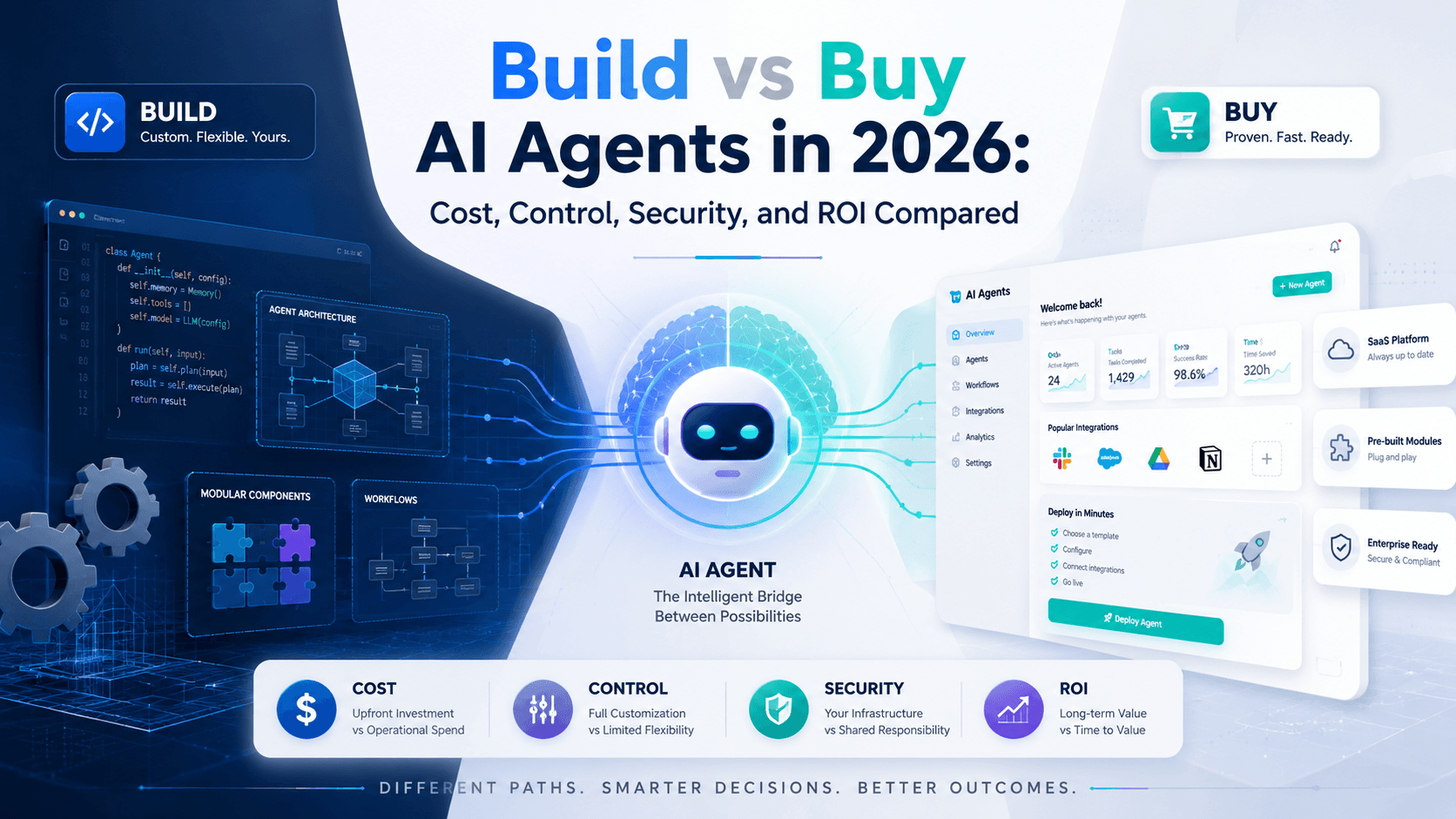
Businesses considering AI agents face an early strategic decision: should they build a custom agent, buy a ready-made product, or combine both approaches?
Buying can deliver value quickly for standardized workflows. Building offers greater control when the agent depends on proprietary processes, data, or integrations. The right answer depends less on the demo and more on total cost, risk, differentiation, and expected return over the agent's full lifecycle.
This guide compares build vs buy AI agents in 2026 and provides a practical framework for making the decision.
Build vs buy AI agents: the short answer
- Buy when the workflow is common, speed matters, and a trusted product already meets most requirements.
- Build when the workflow creates competitive advantage, requires deep integration, or needs unique control over data and behavior.
- Use a hybrid approach when managed infrastructure can accelerate delivery but the business logic and experience must remain custom.
- Run a limited pilot first when value, adoption, or technical feasibility is still uncertain.
What does \u201Cbuild\u201D mean?
Building an AI agent does not usually mean training a foundation model from scratch. A custom agent commonly combines an existing model with business logic, retrieval, tools, integrations, security policies, evaluations, and a user interface.
A business may build using cloud AI services, open-source frameworks, commercial models, MCP servers, vector databases, and internal APIs. The organization owns how these components work together and is responsible for operating the resulting system.
Typical components of a custom AI agent
- Application interface and user authentication.
- Model selection and routing.
- Agent orchestration and workflow state.
- RAG, memory, and business context.
- Tools and integrations with company systems.
- Permissions, approval gates, and guardrails.
- Evaluations, monitoring, audit logs, and cost controls.
What does buy mean?
Buying means adopting a packaged agent or managed platform whose core functionality is designed and operated by a vendor. Examples include agents built into CRM, customer-support, productivity, analytics, or development platforms.
The customer configures the product, connects approved data, sets permissions, and may customize prompts or workflows. The vendor maintains much of the infrastructure, product roadmap, security tooling, and model integration.
Buying is not zero effort. Deployment still requires data preparation, system integration, access governance, testing, user training, process redesign, and ongoing oversight.
Build vs buy comparison
Time to value
Buying normally wins when a product already covers the target workflow. Teams can configure a pilot without first building orchestration, administration, and monitoring infrastructure.
Building takes longer because the team must design, integrate, test, secure, and operate the system. However, customization may reduce downstream workarounds when the real process does not match a packaged product.
Initial cost
A purchased agent commonly starts with subscription, implementation, integration, and training costs. A custom agent starts with discovery, product design, engineering, data preparation, security review, evaluation, and infrastructure setup.
Buying often requires less initial investment. Building becomes reasonable when the expected business value is high enough to justify development or when many users and workflows can share the platform.
Ongoing cost
Purchased solutions may charge by user, task, conversation, token, connector, or usage tier. Custom agents incur model, retrieval, storage, compute, monitoring, maintenance, support, and engineering costs.
Neither option is automatically cheaper at scale. Subscription costs can grow with adoption, while custom systems need continuous ownership. Compare cost per successful business outcome rather than only license fees or model tokens.
Control and customization
Building gives the organization direct control over workflows, user experience, models, prompts, tools, data handling, and release timing. This matters when the agent encodes proprietary operational knowledge.
Purchased products provide configuration within vendor-defined boundaries. This is often sufficient for standardized work but can become restrictive when exceptions, approvals, or integrations are unique.
Integration
A vendor product may offer reliable prebuilt connectors for popular systems. Custom integrations are needed when data lives in legacy platforms, internal services, or specialized industry software.
Building allows the agent to operate across the company's actual system landscape, but every integration creates a dependency that must be secured, tested, and maintained.
Security and compliance
A mature vendor may provide certifications, identity integration, audit features, retention controls, and a dedicated security team. This can reduce implementation burden, but the customer must verify the controls instead of assuming that \u201Centerprise-ready\u201D covers its use case.
Building offers detailed control over data flow, deployment location, logs, permissions, and model providers. It also makes the organization responsible for implementing those controls correctly.
Vendor lock-in
Buying may create dependence on proprietary agent formats, connectors, pricing, models, or stored memory. Migration can become expensive after workflows and users depend on the platform.
A custom system can reduce lock-in through modular architecture, standard APIs, MCP integrations, portable data, and a model gateway. Building still relies on vendors, but the organization controls the boundaries and replacement strategy.
Reliability and support
Purchased products may provide service-level agreements, product support, managed upgrades, and established operations. Custom agents allow faster changes but require internal or external teams to handle incidents, model changes, regression tests, and infrastructure.
The true cost of buying an AI agent
License price is only one part of total cost of ownership. Include:
- Subscriptions and usage charges.
- Premium connectors, storage, and model consumption.
- Implementation and data migration.
- Identity, security, legal, and compliance review.
- Customization and integration services.
- User training and process change.
- Administration, monitoring, and support.
- Future migration or exit costs.
Review how pricing changes with users, tasks, tokens, memory, and tool calls. Current managed platforms can bill agent runtime, gateways, storage, memory operations, evaluation, and model tokens separately, so a low starting price may not represent production cost.
The true cost of building an AI agent
A custom agent's cost extends beyond the first implementation. Include:
- Discovery, workflow mapping, and product design.
- Application and integration development.
- Knowledge preparation and retrieval infrastructure.
- Security controls, approvals, and auditability.
- Evaluation datasets and regression testing.
- Model, token, compute, storage, and observability usage.
- Production support, incident response, and maintenance.
- Updates when models, APIs, data, or business rules change.
Internal engineering time has an opportunity cost. A custom agent must create more value than the other initiatives those people could deliver.
When businesses should buy
Buying is usually appropriate when:
- The workflow is standardized across many companies.
- A product meets most requirements without major workarounds.
- Fast deployment is more important than unique functionality.
- The organization lacks an AI engineering or operations team.
- Required integrations are already supported.
- The vendor's security and compliance controls meet the risk profile.
- The expected usage makes pricing predictable and acceptable.
Common examples include meeting summaries, standard office productivity, basic help-desk assistance, and agent features already embedded in a core SaaS platform.
When businesses should build
Building is usually appropriate when:
- The workflow is a meaningful source of competitive advantage.
- The agent requires proprietary data, rules, or domain expertise.
- It must coordinate several internal or legacy systems.
- Security, deployment, or data-residency requirements are highly specific.
- The company needs control over models, user experience, and roadmap.
- Vendor limits would create costly manual workarounds.
- The system can support multiple valuable workflows over time.
Examples include specialized underwriting, industrial operations, proprietary research, complex logistics, custom customer experiences, and internal software-development workflows.
When a hybrid approach is best
Most production systems are not purely build or buy. A company may buy managed models, identity, hosting, monitoring, or search while building its orchestration, business tools, policies, and user experience.
A hybrid strategy can provide:
- Faster delivery through managed infrastructure.
- Custom workflows where differentiation matters.
- Better portability through standard interfaces.
- Central governance across purchased and custom agents.
- The ability to replace individual components as technology changes.
IBM recommends an open orchestration layer in heterogeneous enterprise environments to reduce vendor lock-in and improve governance. Standards such as MCP can also help separate business integrations from individual AI applications.
How to compare security
For either option, ask:
- Who owns and operates the agent?
- Where are prompts, documents, memory, and logs stored?
- Can the provider use submitted data for training?
- How are users, agents, and service identities authenticated?
- Can permissions be limited per user, tool, record, and action?
- Which high-impact actions require human approval?
- How are prompt injection and tool misuse detected?
- Are actions traceable through audit logs?
- How quickly can access, tools, or the entire agent be revoked?
- What happens to company data when the contract ends?
Google Cloud's governance guidance groups enterprise agent controls around visibility, identity and access, security and compliance, and operational oversight. These pillars are useful whether the system is purchased or custom-built.
How to calculate AI agent ROI
Define the baseline before selecting technology. Measure the current workflow's volume, completion time, labor cost, error rate, waiting time, and customer impact.
A practical annual value model is:
Annual value = tasks per year \u00D7 improvement per task \u00D7 value per improvement \u00D7 adoption rate \u00D7 attribution factor
Then calculate:
ROI = (annual value \u2212 annualized total cost) \u00F7 annualized total cost \u00D7 100%
Include three types of value:
- Speed to outcome: Shorter resolution or processing time.
- Cost to serve: Lower cost for the same or better result.
- New capability: Work the organization could not perform economically before.
Use conservative assumptions and apply an attribution factor when the agent is only one contributor to the result. IBM reports that only 25% of AI initiatives in its cited 2025 C-suite study delivered expected ROI and 16% scaled enterprise-wide, reinforcing the need for a measurable use case and operating model.
A practical build-vs-buy scorecard
Score each category from 1 to 5 for both options:
- Fit with the real workflow.
- Time to first measurable value.
- Three-year total cost of ownership.
- Integration complexity.
- Security and compliance fit.
- Data and model control.
- Expected adoption and user experience.
- Ability to measure quality and ROI.
- Vendor and migration risk.
- Internal skills and long-term ownership.
Weight the categories according to business priorities. A regulated company may give security and auditability more weight, while a low-risk internal pilot may prioritize speed.
A recommended decision process
- Define one workflow: Avoid making a platform decision before identifying a valuable task.
- Establish the baseline: Measure current cost, time, quality, and volume.
- Research existing products: Test whether they meet the real workflow, not only the demo scenario.
- Estimate three-year TCO: Include implementation, usage, people, governance, and exit costs.
- Run a bounded pilot: Use representative data and users.
- Evaluate security and operations: Test permissions, failures, logs, approvals, and shutdown procedures.
- Compare business outcomes: Select the option with the best risk-adjusted value.
Common decision mistakes
- Comparing subscription price with development cost instead of total ownership cost.
- Building a custom platform before proving one valuable workflow.
- Buying based on a polished demo without testing company data and exceptions.
- Ignoring integration, governance, adoption, and support effort.
- Assuming purchased software transfers all security responsibility to the vendor.
- Choosing customization for features that do not create business differentiation.
- Measuring activity or generated output instead of successful outcomes.
Frequently asked questions
Is it cheaper to build or buy an AI agent?
Buying normally has a lower initial cost, while building can become economical for differentiated, high-value, or widely reused workflows. Compare three-year total cost and cost per successful outcome.
How long does it take to build a custom AI agent?
A limited proof of concept may take weeks. Production delivery depends on workflow complexity, integrations, data readiness, security, evaluation, and governance. The chat interface is usually the smallest part of the work.
Does buying an AI agent eliminate security work?
No. The vendor may operate core infrastructure, but the customer still controls configuration, user access, connected data, tools, approvals, retention, and acceptable use.
Can a business switch vendors later?
Yes, but migration difficulty depends on data portability, proprietary workflows, integration formats, stored memory, and contract terms. Plan an exit strategy before adoption.
What should a small business choose?
A trusted packaged product is often the best starting point for common workflows. Custom development is justified when the process is central to the business or existing products cannot support it effectively.
Conclusion
The build-vs-buy decision is not about choosing the most advanced technology. It is about selecting the operating model that produces measurable value with acceptable cost and risk.
Buy when the workflow is standard and speed matters. Build when control, integration, or differentiation creates enough value. Use a hybrid approach when managed components can accelerate delivery while the business retains ownership of its unique logic and data boundaries.
Nextchain helps companies evaluate, design, and develop production-ready AI agents and integrations. Contact Nextchain to compare build, buy, and hybrid options for your workflow.