Businesses often want an AI application to understand private knowledge, follow specialized instructions, use a consistent tone, or perform a narrow task more accurately. Two common approaches are retrieval-augmented generation (RAG) and fine-tuning.
They solve different problems. RAG gives a model relevant external information when it answers. Fine-tuning changes the model's behavior by training it on examples. Choosing the wrong approach can increase cost and complexity without improving the result.
This guide compares RAG and fine-tuning across accuracy, data, maintenance, security, latency, and business use cases.
RAG vs fine-tuning: the short answer
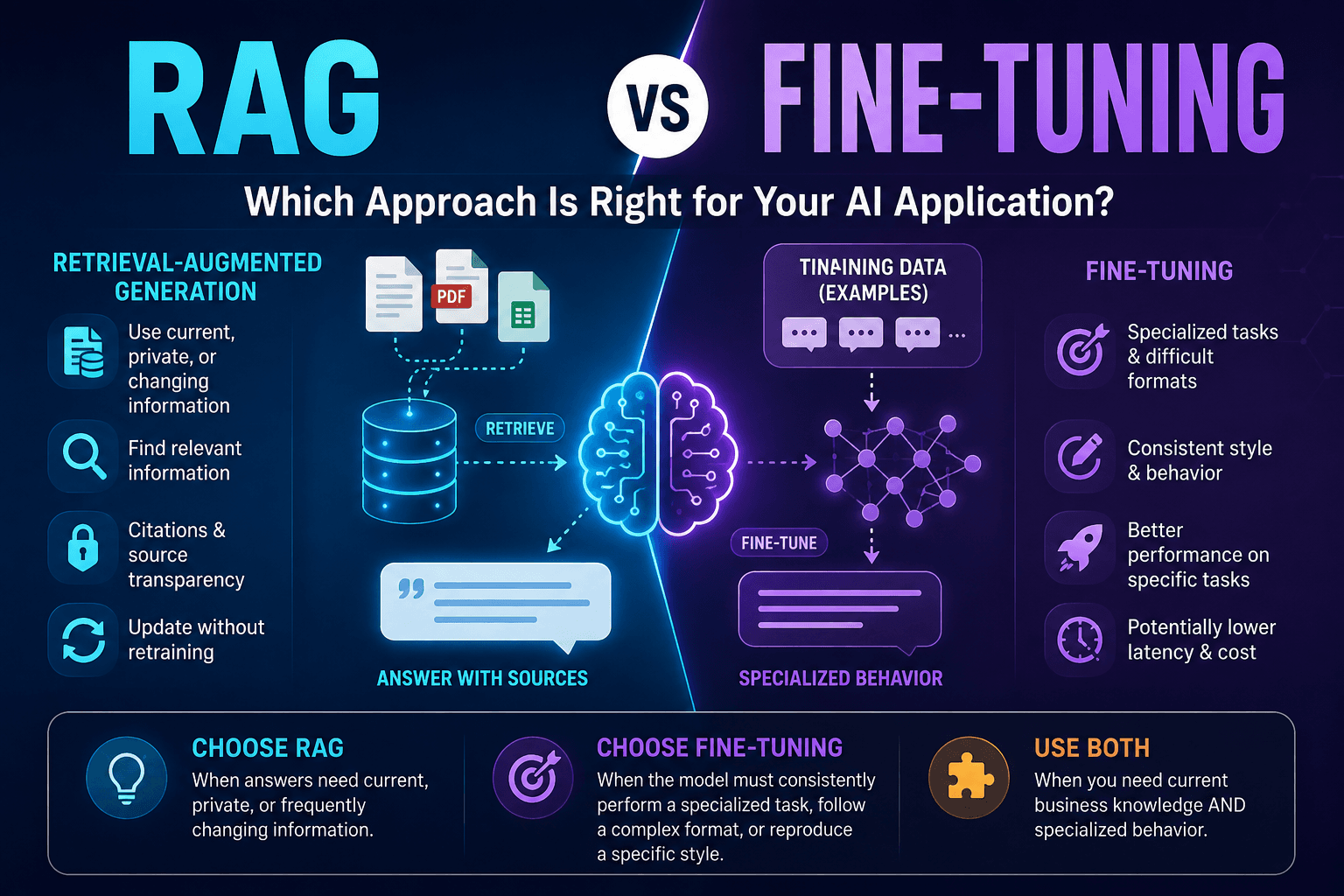
- Choose RAG when answers must use current, private, or frequently changing information.
- Choose fine-tuning when the model must consistently perform a specialized task, follow a difficult format, or reproduce a particular style.
- Use both when the application needs current business knowledge and specialized behavior.
- Start with prompting when the requirement can be explained clearly without adding large amounts of data.
For most enterprise knowledge assistants and RAG chatbots, retrieval is the better first step because business information changes and users need traceable sources. Fine-tuning becomes valuable when repeated evaluations show a consistent behavior or task-performance gap.
What is retrieval-augmented generation?
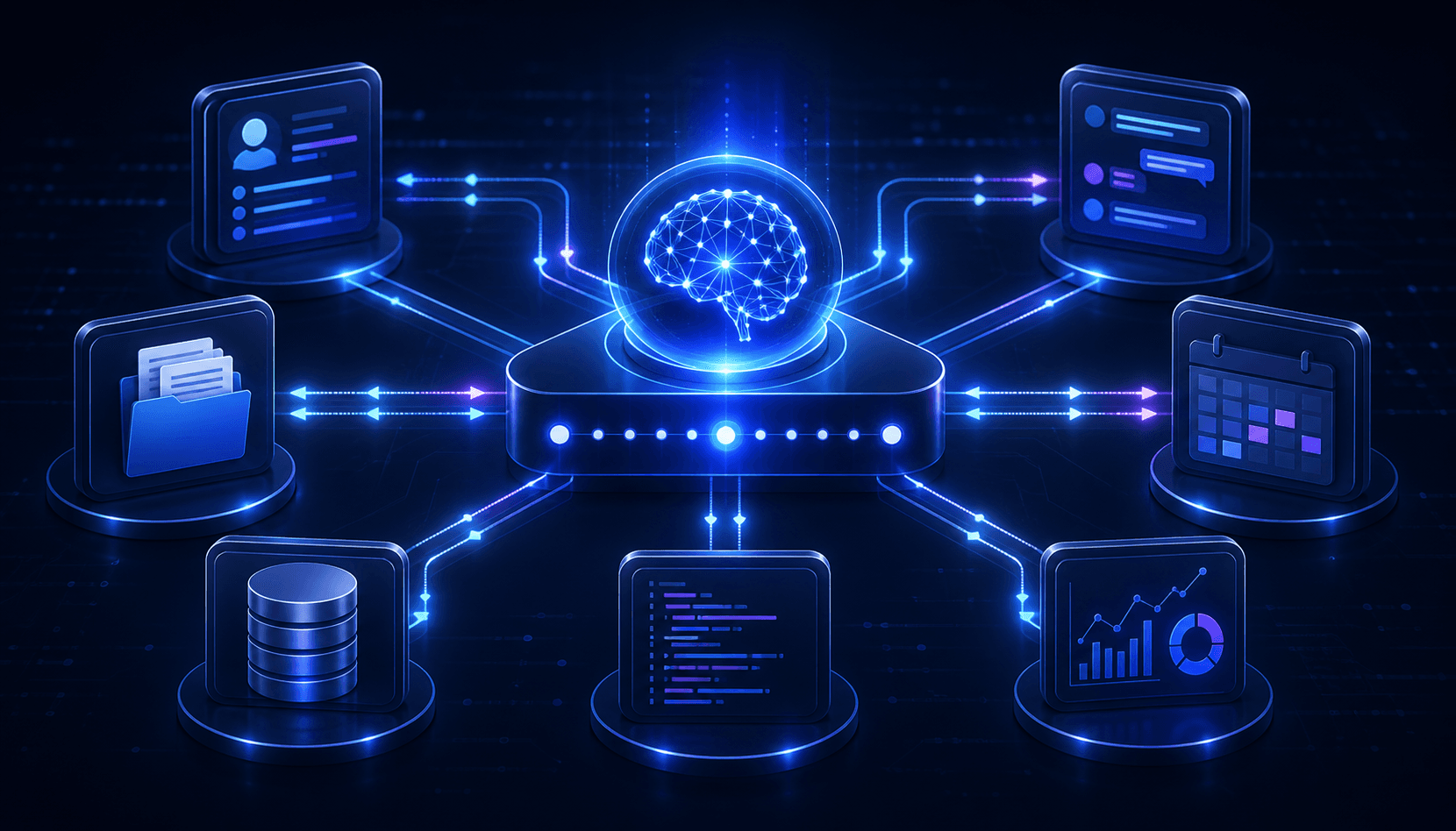
Retrieval-augmented generation connects a language model to an external knowledge source. When a user asks a question, the application searches for relevant information and includes that information in the context sent to the model.
A typical RAG workflow includes:
- Collect and prepare documents or structured data.
- Divide content into searchable units.
- Create embeddings and store them in a search index or vector database.
- Transform the user's question into a retrieval query.
- Find and rank relevant passages.
- Send the question and selected context to the language model.
- Generate an answer with citations or source references.
RAG does not normally change the model's weights. The knowledge can be updated by changing the source documents or index rather than retraining the model.
RAG advantages
- Works with current and frequently updated information.
- Connects models to private company knowledge.
- Can provide citations and evidence for answers.
- Allows records to be updated or removed without retraining.
- Can enforce document, tenant, and user access permissions.
- Works with different models through the same retrieval layer.
RAG limitations
- Answer quality depends heavily on retrieval quality.
- Document processing, chunking, metadata, and ranking require careful design.
- Retrieval adds latency and infrastructure cost.
- Irrelevant or conflicting sources can confuse the model.
- RAG adds knowledge but does not automatically teach a new behavior.
What is fine-tuning?
Fine-tuning continues training a pre-trained model on a smaller dataset of examples for a specific objective. The process updates model parameters so the model becomes better at producing the desired behavior.
A fine-tuning dataset commonly contains pairs of inputs and ideal outputs. Examples might demonstrate how to classify support tickets, extract fields from contracts, produce a specialized JSON structure, write in a brand voice, or answer in an industry-specific style.
Unlike RAG, fine-tuning changes how the model behaves without requiring the same examples to be included in every request.
Fine-tuning advantages
- Improves consistency for narrow, repeatable tasks.
- Can teach complex output formats and style.
- May reduce long prompt instructions and examples.
- Can improve performance with specialized terminology.
- May reduce inference latency or cost when a smaller tuned model replaces a larger general model.
Fine-tuning limitations
- Requires a sufficiently large, representative, high-quality dataset.
- Training, evaluation, versioning, and deployment add operational work.
- Changing factual knowledge may require new data and another training run.
- Poor examples can teach unwanted patterns or bias.
- It is harder to show which training example supports a specific answer.
- Overfitting can reduce performance on unfamiliar inputs.
The core difference: knowledge vs behavior
The most useful way to compare RAG and fine-tuning is to ask what needs to change.
RAG changes the information available at request time. It helps the model answer questions using documents, records, policies, or live business data that were not available during training.
Fine-tuning changes the model's learned behavior. It helps the model respond in a specialized way based on patterns in training examples.
Microsoft's current guidance makes a similar distinction: use RAG for dynamic content and broad knowledge coverage, while fine-tuning is better for stable, task-specific specialization when sufficient training data is available.
RAG vs fine-tuning comparison
Business objective
Use RAG when the goal is to answer from company knowledge. Use fine-tuning when the goal is to change how the model performs a task. Use both when the task requires specialized behavior grounded in current information.
Data requirements
RAG needs useful source content and metadata. It does not require every document to be converted into labeled training examples. Fine-tuning needs representative input-output examples that clearly demonstrate the desired result.
Freshness
RAG is better for changing information because the index can be updated when source data changes. Fine-tuned knowledge remains in a model version until the model is trained again.
Explainability
RAG can return citations or links to retrieved sources, making answers easier to review. Fine-tuning improves model behavior but does not naturally reveal which training example influenced an output.
Latency
RAG adds retrieval, ranking, and context-processing steps. Fine-tuning may provide faster responses for a narrow task, especially when it allows the use of a smaller model. Actual performance should be measured with the target workload.
Cost
RAG has ongoing costs for ingestion, storage, retrieval, reranking, and additional input tokens. Fine-tuning has preparation and training costs plus model hosting or usage costs. The lower-cost option depends on request volume, data change frequency, context size, and model choice.
Maintenance
RAG requires monitoring document pipelines, permissions, search quality, and stale content. Fine-tuning requires dataset governance, training runs, model versioning, regression testing, and retraining when requirements change.
Security
RAG can apply access controls during retrieval, but it may expose sensitive information if filtering is incorrect. Fine-tuning reduces runtime retrieval but may encode sensitive patterns into model weights. Both approaches require data classification, authorization, testing, and retention policies.
When to choose RAG
RAG is usually the best option for:
- Internal knowledge assistants.
- Customer-support chatbots using product documentation.
- Policy, legal, or compliance question answering.
- Product catalogs, prices, inventory, and availability.
- Research tools that need citations.
- Applications using records from CRMs, databases, or business APIs.
- Information that changes more often than a model can be retrained.
RAG works especially well when users need to verify an answer against an authoritative source.
When to choose fine-tuning
Fine-tuning is a strong option for:
- Classification and routing with company-specific labels.
- Reliable structured output for a narrow workflow.
- Specialized extraction from recurring document formats.
- Consistent tone, style, or brand voice.
- Domain-specific language and response patterns.
- High-volume tasks where a smaller specialized model can replace a larger model.
Fine-tuning should be considered after the team has a clear evaluation dataset and can demonstrate that prompting or RAG alone does not meet the target.
When to combine RAG and fine-tuning
RAG and fine-tuning are not mutually exclusive. A hybrid application can use fine-tuning for behavior and RAG for knowledge.
For example, a customer-service assistant may be fine-tuned to classify intent, follow escalation procedures, and produce a consistent response format. RAG can then retrieve the latest policies, product details, and account information for each conversation.
A legal assistant may use a tuned model for contract clause extraction while retrieving current templates and approved guidance through RAG. A technical support tool may use fine-tuning for log classification and RAG for the latest documentation.
AWS and Google Cloud both describe hybrid approaches as appropriate when an application needs specialized output behavior and grounding in current or proprietary data.
Business examples
Example 1: Internal HR assistant
Employees ask about leave policies, benefits, and onboarding procedures. Documents change regularly and answers should cite the source. RAG is the best starting point.
Example 2: Support ticket classification
A company wants every incoming ticket mapped to its proprietary category and priority labels. It has thousands of reviewed examples and the labels are stable. Fine-tuning may improve consistency and reduce prompt size.
Example 3: Customer-support agent
The agent must use the latest product documentation and customer information while following a strict tone and response procedure. A hybrid approach may provide the best result.
Example 4: Financial research assistant
The application must answer from current reports and provide citations. RAG is more appropriate than encoding changing financial information through fine-tuning.
A practical decision framework
- Define the failure: Is the model missing information, or behaving incorrectly?
- Test prompting first: Add clear instructions and a few examples.
- Choose RAG for missing knowledge: Build retrieval when the information is external, private, or changing.
- Choose fine-tuning for repeated behavior gaps: Train only when quality examples and evaluation metrics exist.
- Evaluate a hybrid: Combine approaches if the system needs both specialized behavior and current knowledge.
- Measure the complete system: Compare task success, accuracy, latency, cost, security, and maintenance effort.
Common mistakes to avoid
- Fine-tuning a model only to add frequently changing facts.
- Building RAG when a clear system prompt would solve the problem.
- Using low-quality training examples or unreviewed source documents.
- Evaluating only fluent answers instead of business outcomes.
- Ignoring permissions during document retrieval.
- Assuming fine-tuning automatically eliminates hallucinations.
- Combining both approaches before proving either one is necessary.
Frequently asked questions
Is RAG cheaper than fine-tuning?
RAG is often faster to start because it does not require model training, but it adds ongoing retrieval and context costs. Fine-tuning requires data preparation and training but may lower per-request cost for high-volume specialized tasks. Measure total lifecycle cost.
Does fine-tuning give a model new knowledge?
Fine-tuning can teach domain patterns, but it is not the best method for reliable, changing factual knowledge. RAG is usually better when information must remain current and traceable.
Can RAG improve model behavior?
RAG can supply instructions and examples as retrieved context, but it does not change the model's weights. If a behavior remains inconsistent across many cases, fine-tuning may help.
Can RAG and fine-tuning be used together?
Yes. Fine-tuning can specialize the model's behavior while RAG supplies current, private, and verifiable information.
Which should a business implement first?
Start with prompting. Add RAG when the model needs external knowledge. Consider fine-tuning after collecting quality examples and identifying a measurable behavior gap.
Conclusion
RAG and fine-tuning address different parts of an AI application's performance. RAG connects the model to current knowledge. Fine-tuning teaches the model more specialized behavior. The best choice depends on the problem, data, update frequency, evaluation results, security requirements, and total cost.
Nextchain builds custom RAG chatbots, AI agents, data integrations, and specialized AI applications. Contact Nextchain to evaluate the right architecture for your use case.