Choose an AI agent development company by evaluating evidence, not presentation quality. The strongest vendor can demonstrate a production system, explain how it measures failures, work inside your security boundaries, give you control of code and infrastructure, and define acceptance criteria before development begins. Shortlist three vendors, require the same evidence from each, and score them with a weighted framework rather than selecting the lowest estimate or the most impressive demo.
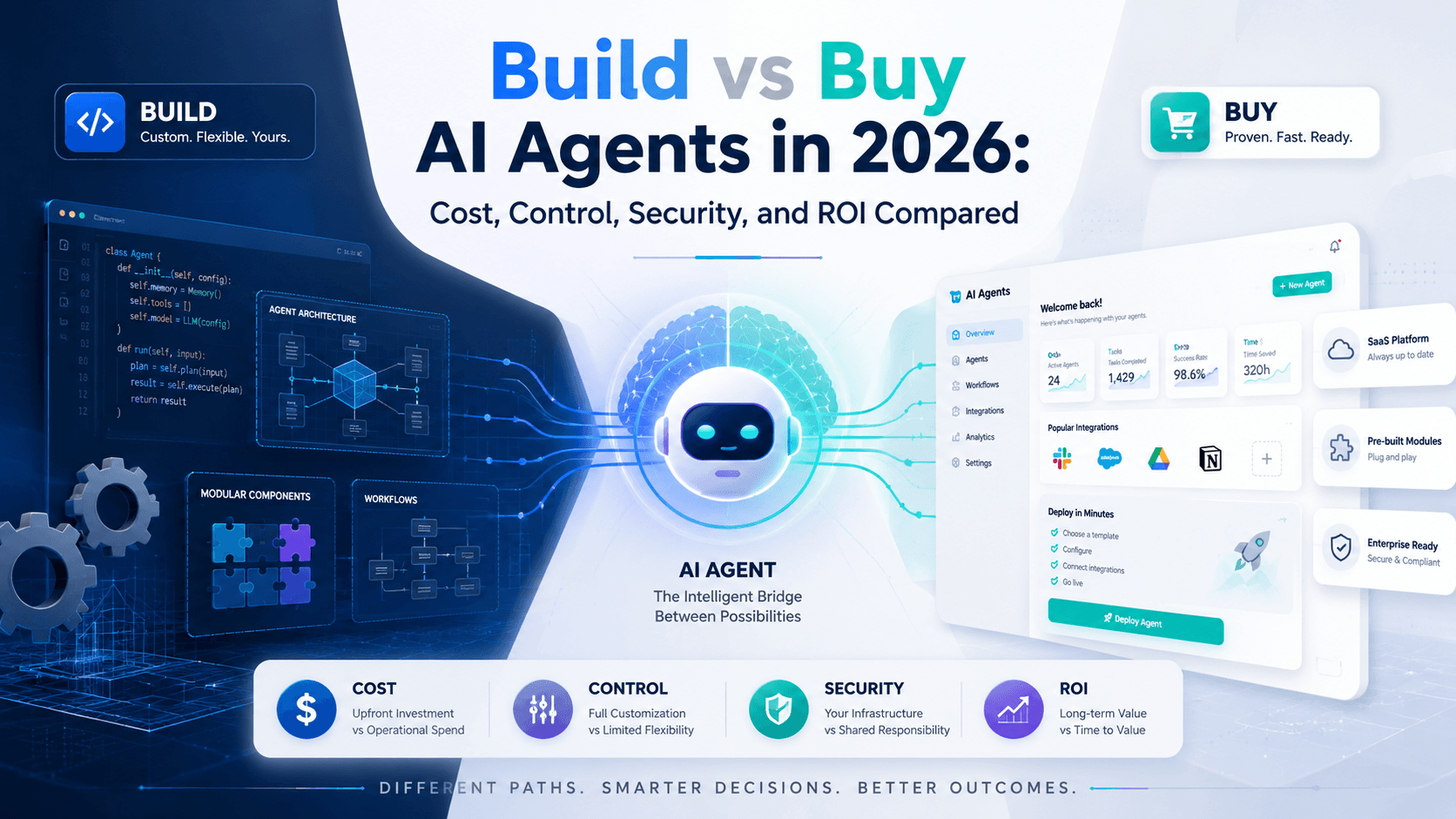
This guide focuses only on vendor selection. If you are still deciding whether to build at all, start with our Build vs Buy AI Agents analysis. For scope, sequence, team, and production gates, use the AI Agent Implementation Roadmap. Keeping those decisions separate prevents a vendor sales process from defining your business case for you.
What you are actually selecting
An AI agent vendor is not merely supplying a model integration. The company may influence how your business process is redesigned, which data is exposed, which systems the agent can change, how quality is measured, and whether your team can operate or replace the system later. The selection process therefore needs to test four capabilities:
- Evidence: has the vendor delivered comparable systems beyond a demonstration?
- Decision quality: can the team challenge an unsuitable use case and explain trade-offs clearly?
- Delivery control: are scope, acceptance, security, communication, and change management explicit?
- Customer independence: can you retain the code, data, accounts, documentation, and ability to change providers?
The checklist below deliberately avoids scoring vendors on model names, fashionable terminology, or the number of agent frameworks in a capabilities deck. Those details change quickly and are poor substitutes for delivery evidence.
Before contacting vendors: prepare a one-page evaluation brief
Vendors cannot produce comparable proposals when each receives a different or ambiguous request. Prepare a one-page brief that describes the decision without prescribing the solution.
| Brief item | What to provide | What not to decide yet |
|---|---|---|
| Workflow | Trigger, current steps, output, exceptions, and monthly volume | A specific model or agent framework |
| Users | Roles, locations, approval responsibilities, and expected adoption | Exact interface design |
| Systems | Named data sources and applications the workflow touches | Integration architecture |
| Risk boundary | Restricted data, prohibited actions, and required human approvals | Detailed security implementation |
| Success | Current baseline and two or three measurable target outcomes | A vendor-specific evaluation method |
| Constraints | Deadline, hosting restrictions, procurement rules, and internal availability | A fixed implementation plan before discovery |
Give the same brief to every candidate. Ask vendors to identify assumptions and missing information separately instead of quietly embedding them in the estimate.
The 15-point AI agent vendor checklist
1. Evidence from a comparable production workflow
Ask for one example comparable in workflow risk, integration depth, user type, or operating environment—not merely the same industry. A customer-service drafting agent with human approval is not equivalent to an agent that can issue refunds or modify financial records.
Request: a redacted architecture overview, the launch scope, the vendor’s responsibilities, time in production, and one measurable operational result. If confidentiality prevents naming the client, the vendor should still be able to describe constraints, decisions, and lessons without disclosing protected information.
2. A live demonstration of failure handling
A prepared happy-path demo proves little. Ask the team to demonstrate an ambiguous request, missing information, a failed tool call, an unauthorized action, and an escalation to a human. The quality of the recovery path is more valuable than a fluent successful response.
Request: a 30-minute session using scenarios supplied by your team at least one day before the meeting. Do not expect access to another customer’s system or data.
3. References you can question directly
Request references from projects that reached real users. Ask what changed after the contract was signed, which assumptions were wrong, how the vendor communicated delays, who handled production incidents, and whether documentation was sufficient for another engineer to continue the work.
Strong evidence: a reference who can discuss the delivery process, not only confirm that the vendor was hired.
4. Problem framing before solution selling
A credible vendor should test whether an AI agent is necessary. Rules, search, workflow automation, or a simpler assistant may solve the problem more reliably. Be cautious when every discovery conversation immediately produces the same multi-agent recommendation.
Ask: “What evidence would make you recommend that we do not build an agent?” A specific answer reveals whether the team is optimizing for your outcome or its preferred technology.
5. Explicit assumptions and decision records
AI projects contain uncertainty around data quality, system access, user behavior, and acceptable error rates. The vendor should maintain an assumption log and record important decisions with alternatives and consequences. This prevents an early guess from becoming an invisible contractual obligation.
Request: a sample decision record and a proposal section listing assumptions, dependencies, exclusions, and customer responsibilities.
6. An evaluation method tied to your workflow
“We will improve the prompts” is not an evaluation plan. The proposal should explain who creates representative test cases, who labels expected outcomes, which failure categories are measured, how regressions are detected, and what threshold blocks release.
Request: an example evaluation report with sensitive details removed. Look for segmented results and failure examples, not only a single accuracy percentage. The technical principles are covered in our production-ready AI agent guide; vendor selection should focus on proof that the team uses them.
7. A written data-flow and trust-boundary review
The vendor should be able to show where user input, retrieved documents, model requests, tool results, logs, and backups travel. The review must identify each external service and the party responsible for its configuration.
Request: a sample data-flow diagram and the standard process for approving third-party subprocessors. NIST’s Generative AI Profile specifically identifies third-party integrations, procurement due diligence, service-level agreements, and supply-chain transparency as areas organizations should address.
8. Least-privilege tool and account design
Ask how the vendor prevents an agent from receiving more functionality, permissions, or autonomy than the workflow requires. OWASP describes this combination as excessive agency. A vendor should separate read and write access, validate tool inputs, restrict actions by user identity, and require approval for high-impact operations.
Request: a permissions matrix mapping users, agent actions, systems, approval requirements, and credential owners. Link the response to the controls in your AI Agent Security Checklist rather than accepting a generic statement that the system is secure.
9. Security ownership after launch
Certifications can support due diligence, but they do not answer who fixes a vulnerable dependency, responds to a leaked credential, reviews model changes, or communicates an incident. CISA’s Secure by Demand guidance recommends evaluating product-security practices in addition to a supplier’s general enterprise security posture.
Request: the vulnerability disclosure process, patch and notification targets, incident roles, dependency-update policy, and security contact. Confirm which activities are included in maintenance and which require a new statement of work.
10. Clear rules for customer data and model training
The agreement should state whether your prompts, documents, outputs, evaluations, and user feedback may be retained or used to improve any vendor or third-party model. “We do not train on your data” is incomplete if logging, support access, subprocessors, deletion, and backups remain undefined.
Request: retention periods, deletion procedure, hosting regions, subprocessor list, support-access controls, and the contractual language governing model training and secondary use.
11. Named delivery team and subcontracting disclosure
Evaluate the people who will perform the work, not only the executives who sell it. The proposal should name the delivery lead and identify the expected roles, allocation, location, and responsibilities. If subcontractors may access code or data, that fact should be disclosed before access is granted.
Request: a proposed team table, escalation path, replacement process, and disclosure of subcontracted responsibilities. Interview the person who will lead weekly delivery.
12. Communication based on working evidence
Status reports can remain green while the product is failing. Prefer vendors that demonstrate working software regularly, maintain a visible risk and decision log, and give you direct access to the delivery lead.
Request: a sample weekly agenda showing completed outcomes, live demonstration, evaluation changes, decisions needed, risks, and next-week commitments. Confirm the working language, time-zone overlap, and response expectations.
13. Acceptance criteria and change control
Traditional acceptance language such as “the chatbot works” is not sufficient. Deliverables should include measurable workflow behavior, supported environments, evaluation thresholds, security gates, documentation, and handover. The contract should also explain how new requirements are estimated and approved.
Request: a sample acceptance matrix and change-request template. Separate acceptance of defined software behavior from business KPIs influenced by adoption or external conditions.
14. Customer ownership and operational access
Decide ownership before development starts. The customer should know who controls the source repository, cloud accounts, domains, model-provider accounts, secrets, observability, prompt and policy configurations, retrieval indexes, evaluation datasets, and deployment pipeline.
Request: an asset-ownership matrix with one owner and one handover condition for every asset. Avoid arrangements where production runs only in a vendor account that the customer cannot inspect or export.
15. A credible exit and handover plan
A mature vendor can explain how another team would take over. The handover package should include source code, deployment instructions, environment inventory, architecture and data-flow diagrams, integration documentation, evaluation assets, runbooks, known limitations, and a final knowledge-transfer session.
Request: the handover checklist as a contractual deliverable, the export format for customer data, a deadline for removing vendor access, and optional transition assistance with a defined rate or limit.
A 100-point vendor scorecard
Score each item from 0 to 5, then calculate the weighted result. Use the same reviewers and evidence standard for every vendor.
| Category | Weight | What earns a high score |
|---|---|---|
| Comparable production evidence | 15 | Relevant reference, measurable outcome, and honest retrospective |
| Failure-handling demonstration | 8 | Safe recovery, escalation, and visible traces under supplied scenarios |
| Problem framing | 7 | Challenges assumptions and considers simpler alternatives |
| Evaluation discipline | 12 | Workflow-specific dataset, failure taxonomy, and release thresholds |
| Data and security governance | 15 | Clear data flow, least privilege, incident ownership, and retention rules |
| Delivery team and communication | 10 | Named team, direct lead access, working demos, and transparent risks |
| Scope, acceptance, and change control | 10 | Testable deliverables, explicit assumptions, and usable change process |
| Ownership and portability | 13 | Customer-controlled accounts, complete asset matrix, and export rights |
| Support and handover | 10 | Runbook, service responsibilities, exit plan, and knowledge transfer |
Scoring formula: for each category, divide the 0–5 rating by 5 and multiply by its weight. A vendor rated 4 for a 15-point category receives 12 points.
| Score | Interpretation | Action |
|---|---|---|
| 85–100 | Strong evidence and controllable delivery risk | Proceed to commercial and reference validation |
| 70–84 | Viable with identifiable gaps | Convert gaps into contract conditions or a paid discovery test |
| 55–69 | Material uncertainty | Do not award full implementation without resolving weak categories |
| Below 55 | Insufficient evidence or control | Remove from shortlist |
Set non-negotiable gates separately from the total score. For example, a high overall score should not compensate for unacceptable data-use terms, missing production ownership, or refusal to disclose subcontractors.
12 questions to ask in the vendor interview
- Show us a comparable system that reached production. What failed after launch?
- What evidence would make you recommend a simpler automation instead of an AI agent?
- Which assumptions in our brief create the largest delivery risk?
- How will you build the evaluation dataset, and who decides what a correct result is?
- Demonstrate how your system handles missing context, a failed tool, and an unauthorized request.
- Which services receive our data, how long is it retained, and who can access it?
- How are agent permissions tied to the requesting user?
- Who is responsible for security patches and incident communication after launch?
- Who will be our delivery lead, and what other projects will that person support?
- What must be true for a deliverable to be accepted?
- Which accounts and assets will we control from the first day?
- If we replace you, what exactly will the next team receive?
Send the questions in advance. The objective is not to surprise candidates; it is to compare the quality and completeness of their answers.
How to compare proposals without being misled by price
Do not compare totals until scope has been normalized. One proposal may include identity integration, evaluation assets, monitoring, documentation, and production support while another describes only a prototype. A lower number can represent a smaller deliverable rather than better value.
| Comparison field | Vendor A | Vendor B | Vendor C |
|---|---|---|---|
| Included workflows and user roles | |||
| Named integrations and environments | |||
| Evaluation deliverables and acceptance thresholds | |||
| Security review and remediation | |||
| Customer-owned accounts and assets | |||
| Documentation and handover | |||
| Warranty, support, and incident response | |||
| Assumptions, exclusions, and customer work |
After normalization, compare commercial terms using the detailed categories in our AI Agent Development Cost guide. This article does not repeat those price ranges because vendor selection and budget estimation are different decisions.
Proposal red flags
- Guaranteed accuracy without a defined dataset: the number cannot be verified.
- A fixed plan built from a short sales call: material assumptions are probably hidden.
- Architecture dominated by product names: business constraints and failure behavior are missing.
- “Enterprise-grade security” without artifacts: no data flow, permissions matrix, or incident ownership is provided.
- A demo presented as production evidence: there are no real users, operating period, or reference.
- Customer data may improve the vendor’s services: secondary use is broader than the project requires.
- Production stays in vendor-controlled accounts: switching cost and operational dependence rise immediately.
- The sales team will determine delivery staffing later: you cannot evaluate the people responsible for execution.
- Acceptance depends only on completing features: quality and safe failure behavior are not contractual.
- Handover is described as “available on request”: deliverables, timing, and transition support are undefined.
A defensible selection process
- Screen five to seven vendors: verify focus, geography, availability, and minimum evidence.
- Shortlist three: issue the same one-page brief, evidence requests, and response deadline.
- Score independently: business, technology, security, and procurement reviewers score before discussing results.
- Run evidence interviews: meet the proposed delivery lead, test failure handling, and resolve assumptions.
- Check references: speak directly with customers whose work reached production.
- Normalize proposals: compare included outcomes, responsibilities, ownership, and support before price.
- Resolve high-risk uncertainty: use a time-boxed paid discovery or technical validation when evidence is insufficient.
- Contract the controls: convert promises about staffing, security, acceptance, ownership, and handover into written obligations.
Keep the scorecard, evidence, reviewer notes, exceptions, and final rationale. The record makes the decision explainable later and gives the delivery team a clear view of the commitments made during procurement.
Evaluating an AI agent project? Nextchain can review the workflow, clarify the evidence vendors should provide, and produce a scoped technical approach before you commit to implementation. Request an AI project assessment.
Frequently asked questions
How many AI development companies should we shortlist?
Shortlist three after an initial screen of approximately five to seven candidates. Three provides enough comparison without creating a procurement process too large for the team to evaluate consistently.
Should we sign an NDA before sharing the project brief?
Use an NDA before sharing confidential workflows, customer information, credentials, proprietary datasets, or detailed system diagrams. The first-stage brief should still minimize sensitive information and provide only what candidates need to qualify the opportunity.
How can a vendor prove production experience without breaking client confidentiality?
The vendor can provide a redacted architecture, describe constraints and responsibilities, disclose the operating duration, share anonymized evaluation or incident examples, and arrange an approved reference call. Confidentiality should limit identifying details, not prevent all evidence.
Should the customer own the AI agent source code?
For custom development, source-code rights and repository control should be explicit. Also address infrastructure, prompts, policies, evaluation data, retrieval indexes, logs, and deployment assets. Source code alone is not enough to operate or transfer a production system.
When should we use paid discovery?
Use paid discovery when integrations, data quality, security constraints, or acceptance criteria are too uncertain for a responsible implementation commitment. Discovery should have fixed deliverables, a time limit, and no obligation to award the later build to the same vendor.
Is the highest-scoring vendor always the correct choice?
No. The scorecard supports judgment rather than replacing it. Apply non-negotiable gates for issues such as prohibited data use, missing ownership, unacceptable subcontracting, or unresolved security risk, and document any reason for choosing a vendor other than the highest score.