Implementing an AI agent is not primarily a model-selection project. It is a business process redesign project with software, data, security, and change-management work around it. A focused agent can reach a controlled pilot in 6–12 weeks, while a production rollout usually takes longer because permissions, integrations, evaluation, and operating ownership must be proven. The safest path is to begin with one measurable workflow, establish a baseline, and expand autonomy only after the system repeatedly meets an agreed quality threshold.
This guide gives business and technology leaders a practical sequence for moving from an attractive idea to a production AI agent that people can trust. The timelines and budgets below are planning ranges, not fixed quotations; integration complexity, data readiness, compliance requirements, and expected reliability can move them substantially.
What an AI agent implementation actually includes
An AI agent is a software system that can interpret a goal, use approved tools or data, make bounded decisions, and complete steps in a workflow. A production implementation therefore contains much more than a large language model. It needs identity and access controls, business-system integrations, retrieval or context management, evaluation datasets, monitoring, cost controls, fallback paths, and a named team responsible for its operation.
A useful distinction is the level of autonomy:
| Level | Agent behavior | Typical example | Recommended control |
|---|---|---|---|
| Assist | Finds information or drafts an answer | Draft a support response from internal documents | Human reviews every output |
| Recommend | Analyzes options and proposes an action | Suggest the next sales follow-up | Human approves the action |
| Act with limits | Executes approved actions inside defined boundaries | Update a CRM field or create a ticket | Policy checks, logs, and rollback |
| Autonomous | Plans and executes multi-step work | Resolve a routine request across several systems | Strict scope, spend limits, escalation, and continuous evaluation |
Most companies should start at Assist or Recommend. Autonomy is not the objective by itself; dependable business outcomes are.
Step 1: choose a workflow, not a broad ambition
“Use AI in customer service” is too broad for an implementation brief. “Draft an answer for tier-one return-policy questions using the approved policy library, then route it to an agent for approval” is specific enough to measure and secure.
A strong first use case has five characteristics:
- Frequent: it occurs often enough to produce meaningful pilot data.
- Bounded: the start, finish, permitted actions, and escalation conditions are clear.
- Measurable: the current time, cost, error rate, or service level is known.
- Recoverable: a wrong suggestion can be reviewed or reversed without serious harm.
- Data-ready: the necessary source material and system access can be made available legally and securely.
| Good first use cases | Poor first use cases |
|---|---|
| Internal policy Q&A with citations | Open-ended strategic decision making |
| Support-ticket classification and draft replies | Fully autonomous handling of angry customers |
| Meeting or document intake into a CRM | Unrestricted write access across the CRM |
| Invoice exception detection for human review | Autonomous payments without approval limits |
| Engineering incident summarization | Production remediation without rollback controls |
Score each candidate workflow from 1 to 5 for business value, frequency, data readiness, integration effort, risk, and reversibility. Select one with visible value and manageable risk, not necessarily the most impressive demonstration.
Step 2: define the business case and baseline
An AI business case needs a baseline before it needs an ROI forecast. Measure how the workflow performs today: monthly volume, handling time, labor cost, rework, error rate, waiting time, and revenue impact. Without that baseline, a faster-looking demo can be mistaken for a business improvement.
A simple first-year model is:
Annual benefit = time saved + avoided errors + additional capacity + revenue impact
First-year cost = implementation + integrations + model usage + hosting + operations + change management
First-year ROI = (annual benefit - first-year cost) / first-year cost
Use a conservative adoption rate. If only 50% of eligible work will use the agent during rollout, do not calculate benefits as if adoption were 100%. Also separate capacity released from cash saved: saving ten minutes does not automatically reduce payroll, but it may shorten response time or allow the same team to handle more work.
Agree on success and stop conditions
Define both the launch gate and the conditions that pause the pilot. A support-drafting agent might require an 85% reviewer acceptance rate, zero exposure of restricted data, grounded citations for every policy answer, and a maximum cost per resolved case. A single severe permission breach should stop the pilot even if average answer quality is high.
Step 3: decide whether to buy, build, or combine
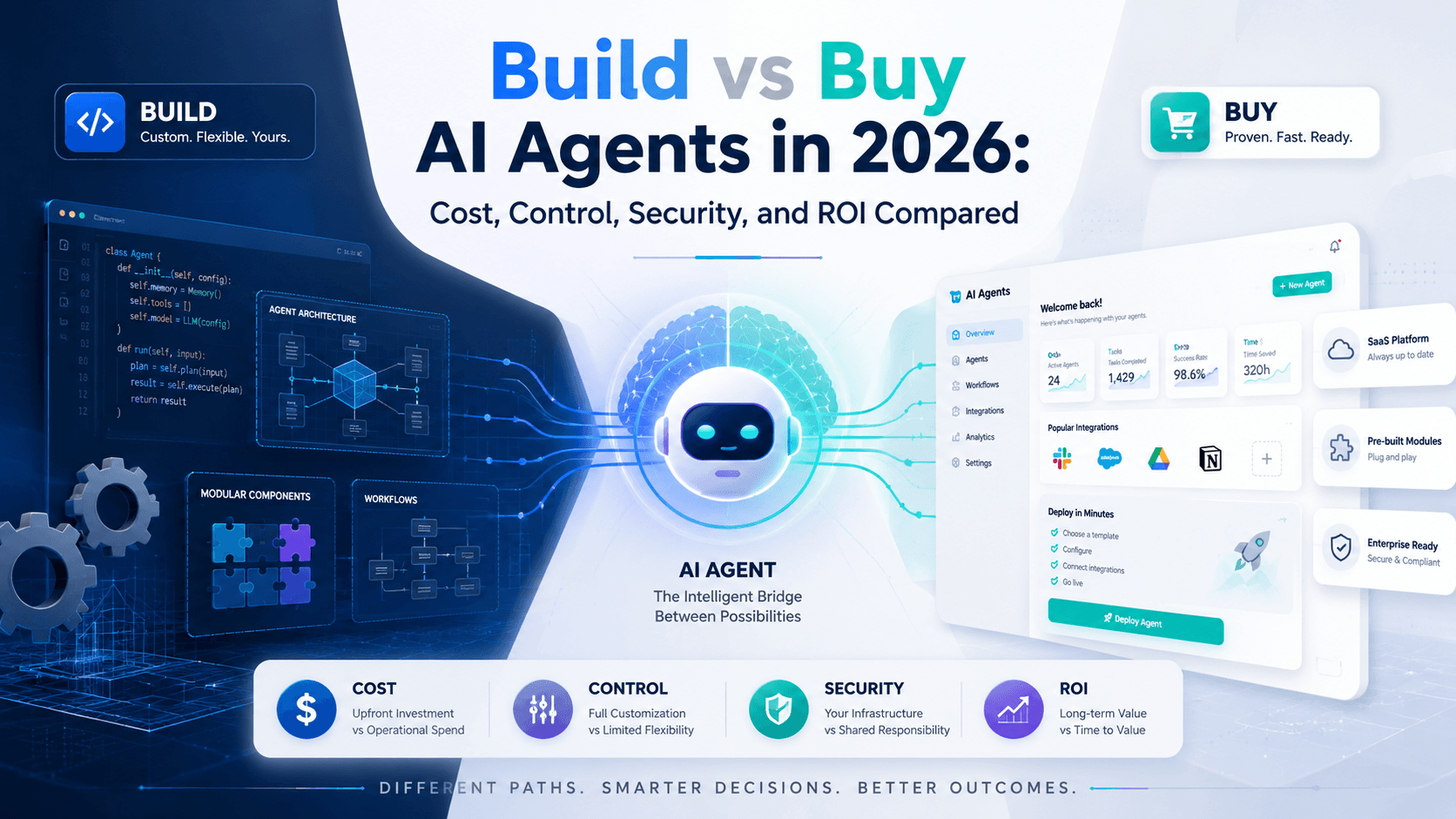
The right delivery model depends on how distinctive the workflow is and how much control the organization needs. Our detailed build-versus-buy comparison covers the financial and security trade-offs; the short decision table is below.
| Approach | Best when | Main advantage | Main constraint |
|---|---|---|---|
| Buy | The workflow is common and fits an existing product | Fast deployment and predictable features | Less control over behavior, data flow, and roadmap |
| Build | The workflow or integration is a competitive differentiator | Control over architecture, evaluation, and user experience | Higher implementation and operating responsibility |
| Hybrid | A platform covers the foundation but custom logic is valuable | Balances speed with differentiation | Requires careful ownership and vendor-boundary design |
Before signing with a platform or development partner, document who owns the source code, prompts, evaluation data, vector indexes, integration credentials, logs, and infrastructure accounts. Also define how data and workflows can be exported if the vendor relationship ends.
Step 4: design the production architecture before the demo
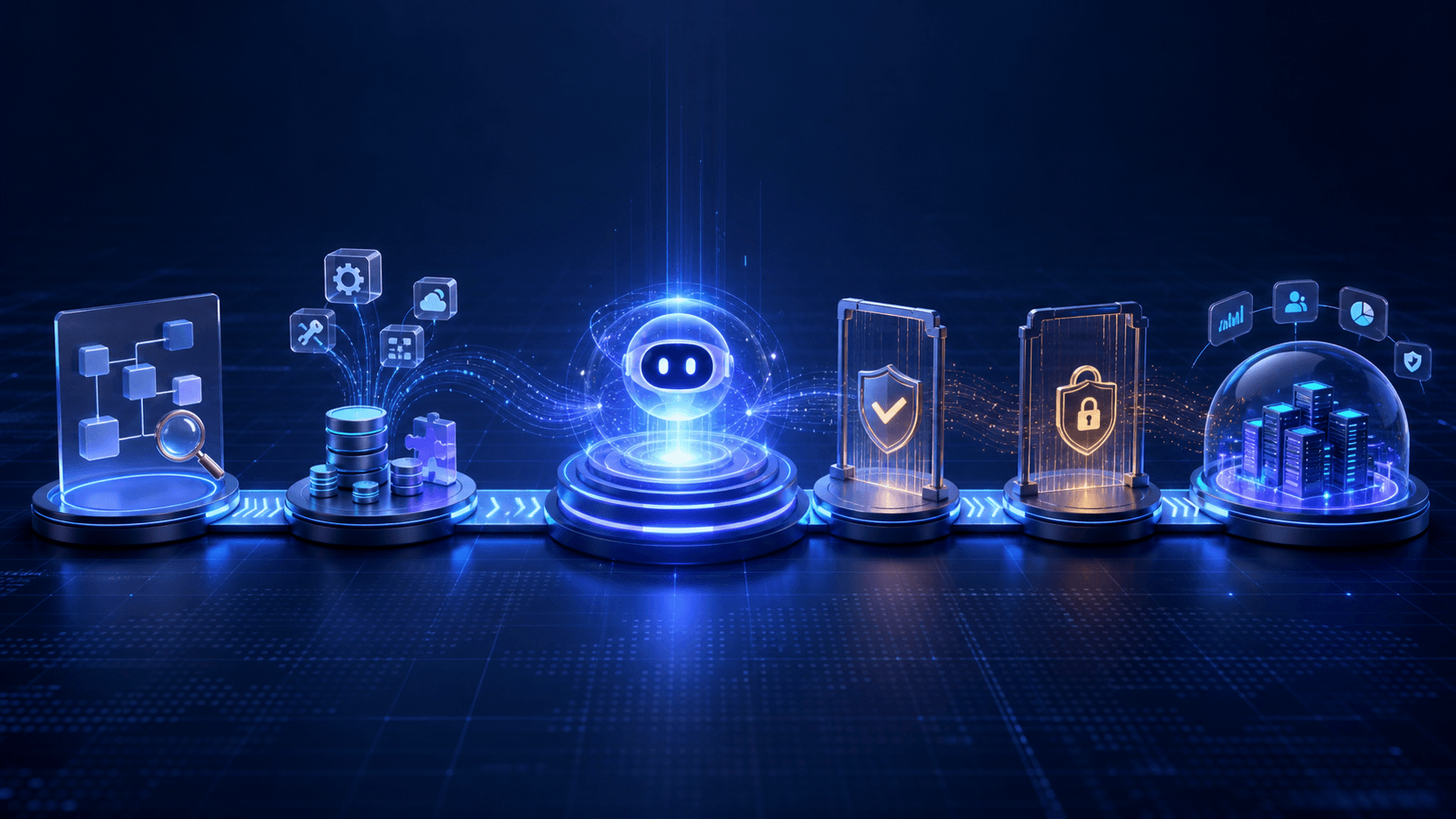
A prototype can call a model and show an answer. A production agent must control how a request moves through identity, policy, context, tools, validation, and monitoring.
- Identity: authenticate the user and preserve their role throughout the request.
- Policy: decide which data, tools, actions, and spending limits are allowed.
- Context: retrieve only the information required for the task.
- Reasoning and orchestration: choose a model and workflow appropriate to the risk and latency target.
- Tool execution: validate parameters before any read or write operation.
- Output validation: check grounding, format, sensitive data, and policy compliance.
- Observation: log decisions, tool calls, latency, model usage, outcomes, and human overrides.
For more depth, see our guide to production-ready AI agent architecture. If the agent must connect to business tools, our MCP explainer describes the protocol and the security boundaries that still need to surround it.
RAG, fine-tuning, or neither?
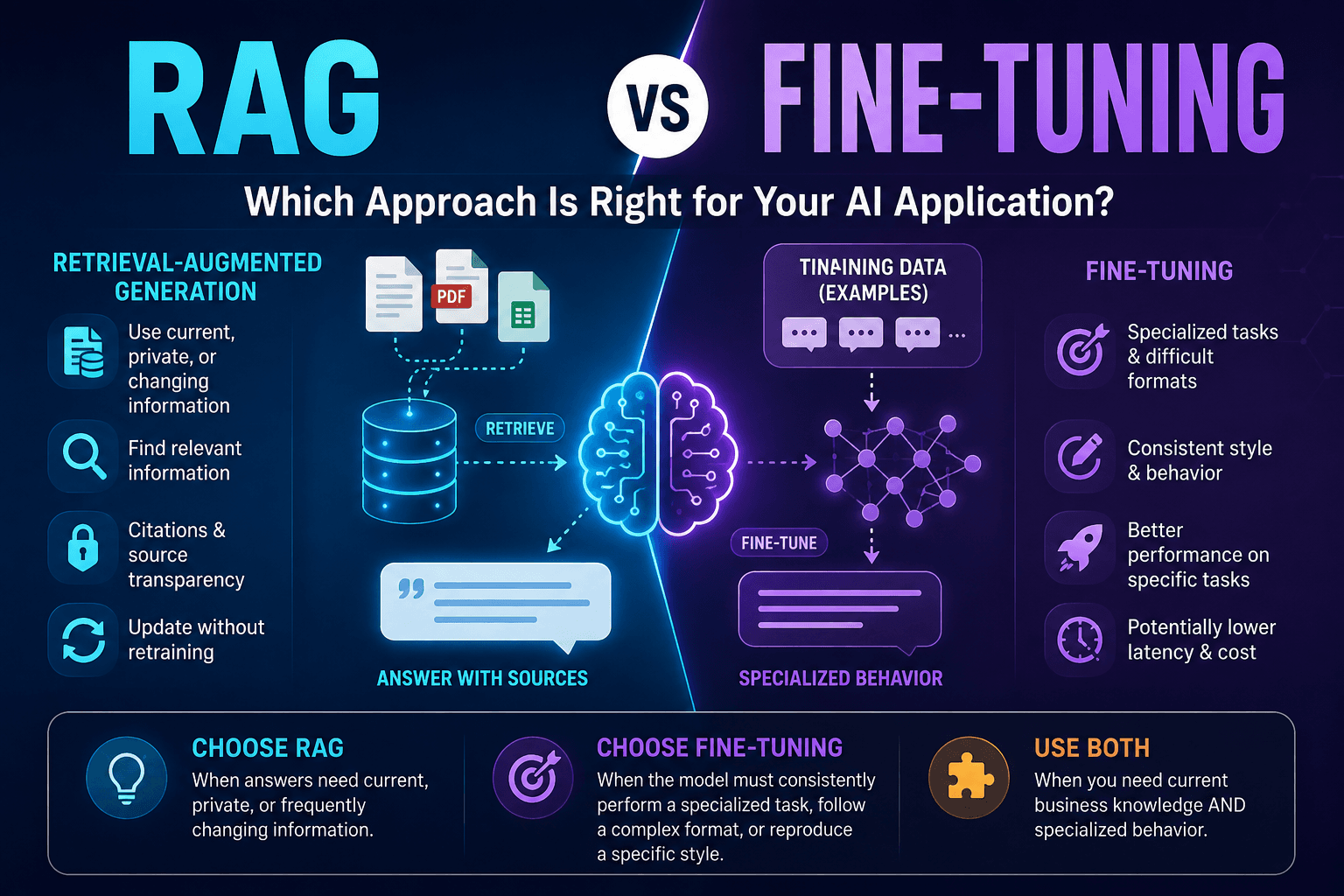
Use retrieval-augmented generation when answers depend on changing private knowledge and need source citations. Fine-tuning is better suited to repeatable behavior, style, or specialized patterns once strong training examples exist. Many workflows need neither at first: structured tool calls and carefully selected context can be enough. Read the full RAG versus fine-tuning decision guide before committing to a data pipeline.
Step 5: build evaluation before adding autonomy
Evaluation is the acceptance test for an AI system. Start with a versioned set of real, anonymized tasks that includes normal requests, ambiguous inputs, missing data, adversarial instructions, and forbidden actions. Domain experts should define what a correct result looks like.
| Evaluation area | Example measure | Why it matters |
|---|---|---|
| Task quality | Correctness or reviewer acceptance rate | Shows whether the output is useful |
| Grounding | Supported claims and valid citations | Reduces confident fabrication |
| Tool reliability | Successful calls, invalid parameters, duplicate actions | Measures execution safety |
| Security | Blocked prompt injection and unauthorized access attempts | Tests control boundaries |
| Operations | Latency, cost per completed task, escalation rate | Determines economic viability |
| Business outcome | Cycle time, rework, conversion, or service level | Connects model behavior to ROI |
Do not rely only on a single average score. Segment results by workflow, user group, data source, and risk category. A 92% average can hide a serious failure in a small but important class of requests.
Step 6: secure the agent as a privileged application
An agent that can read documents and use tools should be treated like a privileged application, not a chatbot. Apply least-privilege access, separate read and write permissions, store secrets outside prompts, require approval for high-impact actions, and retain an auditable record of tool calls. Retrieved content and user input must be treated as untrusted because either can contain instructions designed to manipulate the agent.
Use the 12-control AI agent security checklist during architecture review. The minimum production gate should cover identity, authorization, data classification, prompt-injection defenses, tool validation, approval thresholds, logging, incident response, retention, vendor review, evaluation, and a kill switch.
A practical 12-week implementation roadmap
This schedule fits one bounded workflow with available data and a small number of integrations. Regulated environments, fragmented legacy systems, or 24/7 critical operations usually require additional discovery and validation.
| Weeks | Objective | Key deliverables | Decision gate |
|---|---|---|---|
| 1–2 | Discovery and baseline | Workflow map, use-case score, baseline metrics, data inventory, risk classification | Is the problem valuable, bounded, and measurable? |
| 3–4 | Solution and evaluation design | Architecture, permission model, evaluation set, success thresholds, operating-cost model | Can the proposed controls support the risk level? |
| 5–6 | Controlled prototype | Core workflow, initial retrieval or tools, trace logging, basic reviewer interface | Does it beat a simple non-agent alternative? |
| 7–8 | Integration and hardening | Production-like connectors, policy enforcement, failure handling, security tests | Does it meet quality and security thresholds? |
| 9–10 | Limited pilot | Small user cohort, human approval, usage analytics, feedback and incident process | Is the business outcome better than baseline? |
| 11–12 | Production readiness | Runbook, dashboards, cost alerts, training, ownership matrix, rollout and rollback plan | Approve, revise, or stop based on evidence |
A useful pilot ends with a decision, not merely a demonstration. Approving wider rollout, revising the use case, switching to a simpler automation, or stopping the project can all be successful outcomes if the evidence is clear.
Team and ownership
A first implementation does not require a large AI department, but it does require accountable roles. One person may cover several roles in a smaller organization.
- Business owner: owns the outcome, adoption, and process change.
- Domain expert: defines correct answers, edge cases, and evaluation criteria.
- Product or delivery lead: controls scope, priorities, and decision gates.
- AI/software engineer: builds orchestration, integrations, evaluation, and observability.
- Security and data owner: approves access, retention, vendors, and incident controls.
- Operations owner: handles monitoring, support, model changes, and ongoing evaluation after launch.
The operations owner must be named before production approval. Otherwise, quality declines silently as documents, models, APIs, and business rules change.
Planning budget and timeline
AI agent cost is driven less by the chat interface than by integration depth, data condition, security requirements, evaluation effort, and expected reliability. The ranges below are broad planning benchmarks in US dollars; they are not a Nextchain quotation.
| Scope | Typical characteristics | Indicative delivery | Indicative implementation |
|---|---|---|---|
| Focused proof of concept | One workflow, sample data, minimal integration, no production SLA | 3–6 weeks | $15,000–$40,000 |
| Controlled departmental pilot | One or two systems, identity, evaluation, human approval, monitoring | 6–12 weeks | $40,000–$120,000 |
| Production multi-system agent | Several integrations, strong security, auditability, support and rollout | 3–6+ months | $120,000–$350,000+ |
Plan separately for ongoing model usage, hosting, monitoring, support, evaluation maintenance, and changes to connected systems. Our AI agent development cost guide provides a more detailed breakdown.
Common reasons AI agent projects fail
- The scope is a department rather than a workflow. The team cannot define success or finish discovery.
- The demo becomes the architecture. Identity, permission, evaluation, and failure handling arrive too late.
- No baseline exists. Stakeholders cannot prove that the agent improved the business process.
- Autonomy grows faster than evidence. The agent gains write access before its failure modes are understood.
- Data ownership is unclear. The project stalls while teams debate access, retention, or document quality.
- Human review is treated as temporary. Review is removed before the team knows which cases require escalation.
- No one owns production quality. Model, prompt, document, or API changes degrade the system without detection.
Your implementation readiness checklist
- We selected one bounded, frequent, and recoverable workflow.
- We measured the current process and agreed on business success metrics.
- We identified the required data, systems, owners, and legal constraints.
- We defined quality, security, cost, and stop thresholds before building.
- We chose buy, build, or hybrid based on control and differentiation.
- We created a representative evaluation dataset.
- We designed least-privilege access and human approval for high-impact actions.
- We budgeted for ongoing operations, not only implementation.
- We named a business owner and a production operations owner.
- We have a rollback or shutdown path if the agent behaves unexpectedly.
Need an implementation plan for a specific workflow? Nextchain can help assess the use case, architecture, delivery model, and production risks before you commit to a full build. Book a consultation to turn the idea into a scoped roadmap.
Frequently asked questions
How long does it take to implement an AI agent?
A focused proof of concept commonly takes 3–6 weeks, while a controlled pilot often takes 6–12 weeks. Production deployment can take 3–6 months or longer when it includes several integrations, regulated data, high availability, or organization-wide rollout.
How much does AI agent implementation cost?
Broad planning ranges start around $15,000–$40,000 for a focused proof of concept, $40,000–$120,000 for a departmental pilot, and $120,000 or more for a production multi-system implementation. Data preparation, integration, security, and reliability requirements are usually larger cost drivers than model usage.
Should we build an AI agent or buy a platform?
Buy when the workflow is standardized and an existing product fits it. Build when the workflow is strategically distinctive or requires deep control over integrations, security, evaluation, and user experience. A hybrid approach is often suitable when a platform provides the foundation and custom logic creates the business value.
Who owns the source code and data in a custom project?
Ownership must be explicit in the contract. It should cover source code, prompts, evaluation datasets, indexes, infrastructure accounts, integration credentials, logs, and export rights. Customers should retain control of their production accounts and business data.
Does an AI agent need ongoing maintenance?
Yes. Models, APIs, documents, permissions, costs, and business rules change. Production ownership should include monitoring, incident response, evaluation regression tests, security review, knowledge updates, and controlled model or prompt releases.
How should business and development teams communicate during implementation?
Use a weekly working demonstration, a shared decision log, named owners for data and integrations, and written acceptance thresholds. Domain experts should review real outputs throughout the pilot instead of waiting for a final presentation.